
The .338 ARC was designed to do something unusual: deliver heavy .338-caliber performance from the compact AR-15 platform while supporting both subsonic and supersonic ammunition.
That dual capability is one of the biggest reasons the cartridge has gained attention.
A shooter can select a heavy subsonic load for suppressed applications or move to a lighter, faster supersonic projectile when flatter trajectory and additional velocity are priorities.
But .338 ARC subsonic and supersonic ammunition behave very differently.
Understanding those differences is essential when choosing ammunition, barrel configuration and a suppressor for a .338 ARC.
What Is .338 ARC Ammo?
The .338 Advanced Rifle Cartridge, commonly called .338 ARC, is a .338-caliber cartridge developed by Hornady for the AR-15 and micro-action bolt-rifle platforms.
Unlike larger .338 cartridges that require a larger action, .338 ARC packages a relatively large-diameter projectile into a cartridge designed around the smaller AR-15 architecture.
Hornady's current .338 ARC ammunition lineup spans projectile weights from 170 grains through 307 grains, including both supersonic and subsonic offerings.
That range gives .338 ARC two distinct personalities:
Supersonic .338 ARC emphasizes velocity, trajectory and hunting/field performance.
Subsonic .338 ARC emphasizes heavy projectiles and suppressed shooting.
What Is .338 ARC Subsonic Ammo?
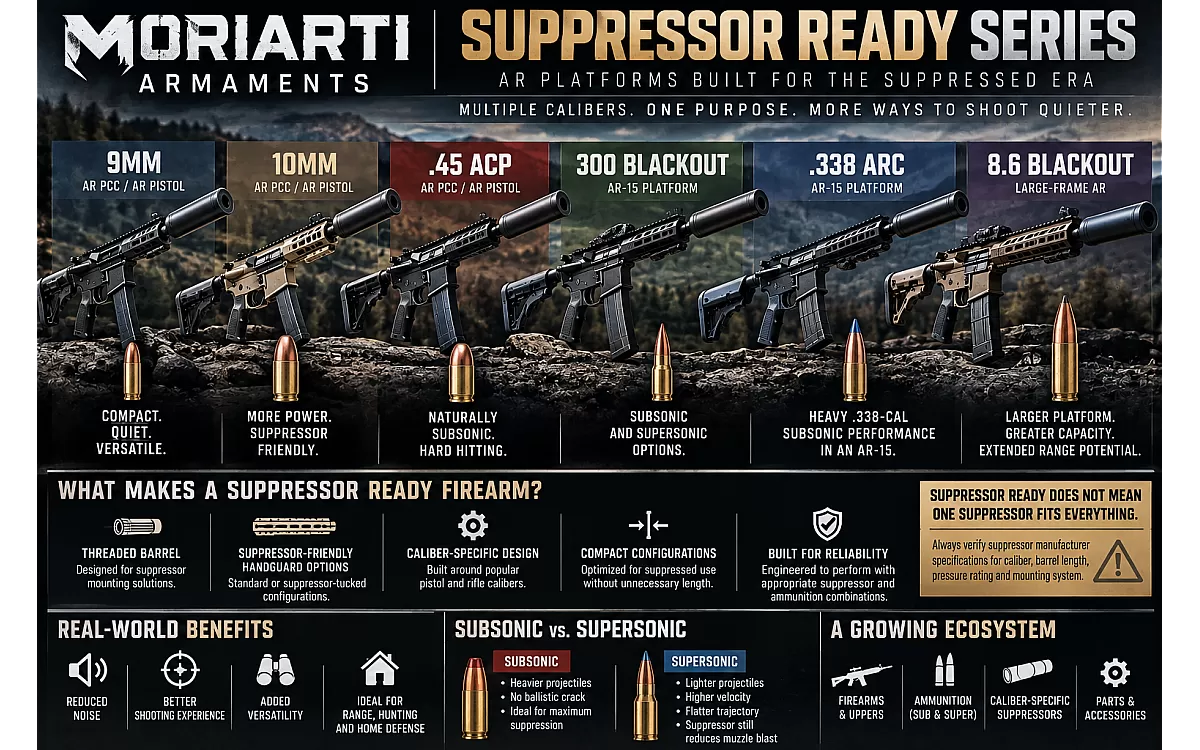
Subsonic ammunition keeps the projectile below the local speed of sound.
This matters when shooting suppressed because a suppressor primarily reduces muzzle blast. A projectile traveling faster than sound creates its own ballistic crack after leaving the muzzle.
A subsonic projectile avoids that supersonic crack.
The tradeoff is velocity.
Because kinetic energy depends heavily on velocity, subsonic cartridges commonly compensate by using substantially heavier projectiles.
That's exactly what .338 ARC does.
Hornady's 307-grain Sub-X is the flagship example. Hornady lists the factory load at 1,050 fps from a 16-inch test barrel.
A projectile weighing more than 300 grains traveling at subsonic velocity from an AR-15-size platform is a major part of what separates .338 ARC from conventional AR-15 cartridges.
What Is .338 ARC Supersonic Ammo?
Supersonic .338 ARC takes the opposite approach.
Instead of maximizing projectile mass while remaining below the sound barrier, these loads use lighter bullets at substantially greater velocity.
Hornady's current lineup includes several examples:
| .338 ARC Load | Type | Published Velocity* | Primary Emphasis |
|---|---|---|---|
| 170gr MonoFlex BLACK | Supersonic | 2,075 fps | Hunting |
| 175gr HP Match BLACK | Supersonic | 2,075 fps | Target / general performance |
| 215gr FTX BLACK | Supersonic | 1,750 fps | Hunting |
| 285gr Frontier FMJ | Subsonic | 1,050 fps | Range / suppressed shooting |
| 307gr Sub-X | Subsonic | 1,050 fps | Suppressed / expanding subsonic |
*Published factory velocities are based on Hornady's listed 16-inch test barrel and should not be treated as guaranteed velocities from every firearm. Actual velocity varies with barrel length, ammunition lot, environmental conditions and firearm configuration.
This expanding ammunition selection is important.
.338 ARC is no longer simply a choice between one light supersonic load and one heavy subsonic load.
Shooters now have meaningful options on both sides.
.338 ARC Subsonic vs. Supersonic
The easiest way to understand the difference is to look at what happens when projectile weight and velocity move in opposite directions.
Subsonic .338 ARC
Heavy projectiles around the upper end of the cartridge's weight range travel below the speed of sound.
The advantages include reduced ballistic crack when suppressed and substantial projectile mass.
The disadvantages include significantly greater trajectory drop and lower velocity.
Supersonic .338 ARC
Lighter projectiles travel considerably faster.
That produces a flatter trajectory and makes the supersonic side of .338 ARC more appropriate when increased distance or hunting performance is the objective.
A suppressor can still reduce muzzle blast with supersonic ammunition, but it cannot eliminate the ballistic crack produced by a projectile traveling faster than sound.
285gr vs. 307gr .338 ARC Subsonic Ammo
The addition of the 285-grain Frontier FMJ gives .338 ARC shooters an important alternative to the 307-grain Sub-X.
The two loads shouldn't be treated as interchangeable simply because both are subsonic.
285gr Frontier FMJ
The Frontier load uses an FMJ projectile and is positioned as a more straightforward subsonic shooting option.
That makes it particularly interesting for range use and shooters who want to practice with a heavy subsonic .338 ARC load without necessarily needing an expanding projectile.
307gr Sub-X
The heavier 307-grain load uses Hornady's Sub-X projectile, which was specifically developed to provide expansion at subsonic velocities.
Hornady describes the Sub-X design as incorporating a polymer Flex Tip and other design features intended to facilitate expansion at lower velocities.
That gives the two loads different purposes:
285gr FMJ → practice/general subsonic shooting
307gr Sub-X → applications where an expanding subsonic projectile is desired
Always select ammunition appropriate for the intended application.
170gr vs. 175gr vs. 215gr .338 ARC
The supersonic side of .338 ARC is becoming equally interesting.
170gr MonoFlex
The 170-grain MonoFlex is a hunting-oriented projectile.
It's the lightest of Hornady's current .338 ARC factory offerings and emphasizes velocity rather than the heavy-projectile philosophy of the subsonic loads.
175gr HP Match
The 175-grain HP Match provides another high-velocity option.
This was one of the cartridges that helped establish the supersonic side of .338 ARC when the cartridge was introduced.
215gr FTX
The 215-grain FTX occupies an interesting middle ground.
At Hornady's published 1,750 fps, it's substantially faster than the subsonic loads while carrying considerably more projectile weight than the 170- and 175-grain offerings.
That illustrates something important about .338 ARC:
It isn't simply a subsonic cartridge that happens to have supersonic ammunition.
The growing range of projectile weights gives shooters several distinctly different ballistic options.
Which .338 ARC Ammo Is Best for a Suppressor?
This question needs an important distinction.
Both subsonic and supersonic .338 ARC can be fired suppressed when the suppressor is appropriately rated for the cartridge and firearm configuration.
The difference is sound behavior.
With subsonic ammunition, there is no supersonic ballistic crack.
With supersonic ammunition, the suppressor can reduce muzzle blast, but the projectile itself still creates a sonic crack as it travels.
That's why heavy 285gr and 307gr subsonic ammunition will generally be the loads of greatest interest to shooters specifically building a suppressed .338 ARC.
But ammunition is only one part of the system.
Suppressor compatibility must be verified against the manufacturer's specifications for:
caliber, cartridge, barrel length, pressure and firing schedule.
A suppressor having a bore large enough for a .338 projectile does not automatically mean it's approved for every .338-caliber cartridge.
This is also why .338-caliber suppressors belong in their own category rather than being grouped with conventional .30-cal suppressors.
Does Barrel Length Affect .338 ARC Ammo?
Yes.
Published ammunition velocity is generated using a specific test-barrel length.
Shortening the barrel generally changes muzzle velocity, although the exact difference depends on the ammunition and firearm.
This is especially important with .338 ARC because many shooters are interested in compact configurations.
A short barrel combined with a suppressor can produce a compact overall package, but the shooter shouldn't expect ammunition to duplicate velocity figures generated from Hornady's 16-inch test barrel.
Subsonic ammunition also deserves special consideration because remaining below the sound barrier is part of its intended behavior.
Environmental conditions and firearm configuration can influence actual measured velocity.
For that reason, factory velocity figures should be treated as a reference point rather than a guarantee from every barrel length.
Does .338 ARC Subsonic Cycle an AR-15?
The cartridge was engineered with semi-automatic operation in mind.
Hornady specifically developed .338 ARC to provide reliable operation with both subsonic and supersonic ammunition in compatible platforms.
But that doesn't mean every combination of aftermarket components will behave identically.
Reliable cycling depends on the complete system, including the:
- Barrel and gas port
- Gas system
- Bolt carrier group
- Buffer and spring
- Ammunition
- Suppressor
- Magazine
A suppressor can also alter the amount of gas available to operate the firearm.
For shooters planning to use both subsonic and supersonic ammunition, choosing a complete .338 ARC upper or properly matched components can simplify the process.
What Magazine Does .338 ARC Use?
.338 ARC remains an AR-15 cartridge, but it does not mean every standard 5.56 magazine is appropriate.
The cartridge's case geometry requires a compatible magazine designed to feed the cartridge reliably.
This is one reason magazines deserve their own place within the .338 ARC ecosystem.
The firearm should be treated as a system:
.338 ARC Barrel → Correct Bolt → .338 ARC Magazine → Appropriate Ammo → Compatible Suppressor
Getting each component right becomes particularly important when switching between very different ammunition types such as a 170-grain supersonic load and a 307-grain subsonic load.
.338 ARC Ammo vs. 300 Blackout Ammo
300 Blackout remains the benchmark for subsonic AR-15 ammunition because of its enormous existing ecosystem.
But .338 ARC approaches the problem differently.
Popular 300 Blackout subsonic ammunition commonly uses projectiles around the 190–220-grain range.
.338 ARC can move into the 285–307-grain range while remaining within the AR-15 platform.
Hornady has stated that its 307-grain .338 ARC subsonic configuration delivers approximately 1.5 times the energy of 300 Blackout Subsonic in the company's comparison.
That doesn't make 300 Blackout obsolete.
300 BLK offers exceptional ammunition availability, extensive suppressor support and one of the most mature alternative-caliber ecosystems available for the AR-15.
.338 ARC instead gives shooters another choice when substantially heavier subsonic projectile mass is the priority.
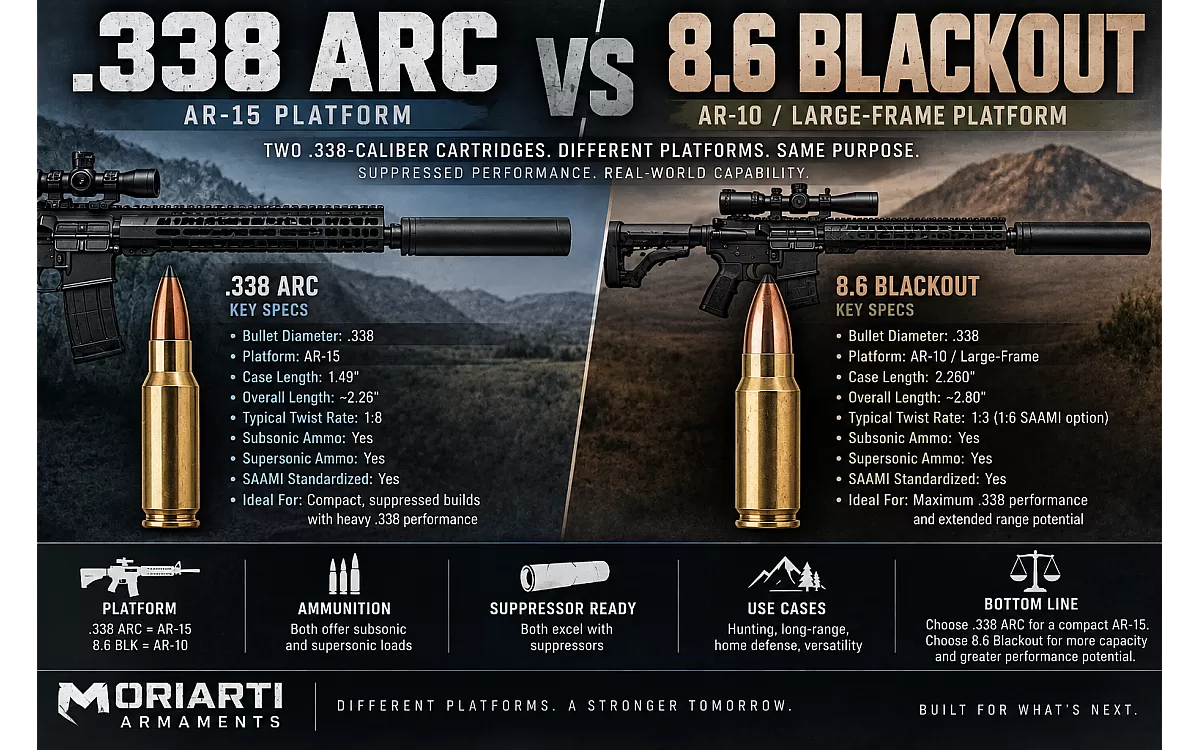
.338 ARC Ammo vs. 8.6 Blackout Ammo
The comparison with 8.6 Blackout is different.
Both cartridges fire .338-caliber projectiles and both support heavy subsonic ammunition.
But .338 ARC was engineered around the AR-15, while 8.6 Blackout occupies the larger AR/short-action ecosystem.
That larger architecture gives 8.6 Blackout greater cartridge capacity.
.338 ARC trades some of that capacity for the ability to achieve heavy .338-caliber performance from the smaller AR-15 platform.
For the complete platform comparison, see our .338 ARC vs. 8.6 Blackout guide.
Is .338 ARC Ammo Good for Hunting?
It can be, provided the ammunition is appropriate for the game and expected impact velocity.
This is where bullet construction matters enormously.
A projectile intended for target shooting isn't automatically interchangeable with a projectile engineered for hunting.
Hornady's current .338 ARC lineup makes those distinctions easier:
170gr MonoFlex → hunting-oriented
175gr HP Match → match/general performance
215gr FTX → hunting-oriented
285gr FMJ → subsonic range/general shooting
307gr Sub-X → expanding subsonic
Distance also matters.
Heavy subsonic projectiles have significantly more trajectory drop than the faster supersonic loads.
For hunting at greater distances, a suitable supersonic load will generally provide a flatter trajectory.
Hunters should always verify ammunition suitability for the intended game and applicable state regulations.
Choosing the Right .338 ARC Ammo
There isn't one universally best .338 ARC load.
The correct ammunition depends on what you want the firearm to do.
For quiet suppressed shooting, start by looking at the heavy 285gr and 307gr subsonic offerings.
For target shooting with greater velocity, the 175gr HP Match provides a very different ballistic profile.
For hunting, consider the intended game, distance and projectile design when evaluating the 170gr MonoFlex, 215gr FTX or appropriate Sub-X application.
For shooters wanting maximum versatility, the real appeal of .338 ARC may be owning a platform capable of using both sides of the ammunition spectrum.
That's what separates the cartridge from many traditional rifle chamberings.
Frequently Asked Questions About .338 ARC Ammo
Is all .338 ARC ammo subsonic?
No. .338 ARC is available in both subsonic and supersonic ammunition. Current Hornady offerings range from 170-grain supersonic ammunition through 307-grain subsonic ammunition.
What is the heaviest factory .338 ARC ammo?
Hornady currently offers a 307-grain Sub-X Subsonic load, which is the heaviest load in its listed factory .338 ARC lineup.
What .338 ARC ammo is subsonic?
Hornady currently lists 285gr Frontier FMJ and 307gr Sub-X subsonic offerings, both with published velocities of approximately 1,050 fps from its specified test barrel.
What .338 ARC ammo is supersonic?
Current Hornady offerings include 170gr MonoFlex, 175gr HP Match and 215gr FTX supersonic loads.
Is .338 ARC good suppressed?
Suppressed use is one of the cartridge's principal attractions, particularly with heavy subsonic ammunition. The suppressor must be specifically compatible with .338 ARC and the firearm's barrel length and configuration.
Can I shoot supersonic .338 ARC through a suppressor?
Yes, provided the suppressor manufacturer rates the suppressor for that ammunition, cartridge and barrel length. The suppressor can reduce muzzle blast, but a supersonic projectile will still produce a ballistic crack.
Does .338 ARC use an AR-15?
Yes. .338 ARC was developed specifically to provide .338-caliber capability from the AR-15-size platform.
One Cartridge, Two Very Different Personalities
The most interesting characteristic of .338 ARC ammo may not be any single ballistic number.
It's the range.
At one end is a 307-grain subsonic expanding projectile traveling around 1,050 fps.
At the other are 170- and 175-grain projectiles with published velocities above 2,000 fps.
And between them sits a growing selection of ammunition designed for different purposes.
That means a .338 ARC AR-15 isn't necessarily limited to being a dedicated subsonic firearm or a conventional supersonic rifle.
The cartridge was designed to operate in both worlds.
For shooters interested in suppressed AR-15s, heavy projectiles and emerging calibers, that's exactly why .338 ARC has become one of the most interesting additions to the AR-15 ecosystem.