
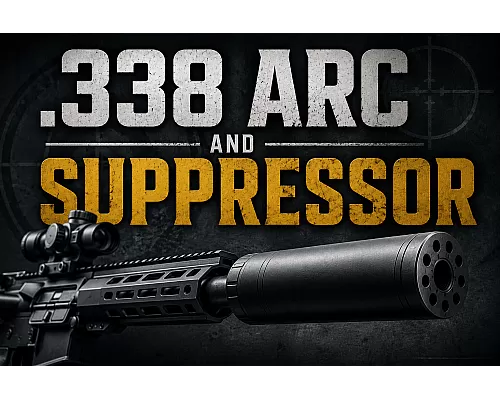
Why .338 ARC and Suppressors Belong in the Same Conversation
The .338 ARC isn't simply another new AR-15 cartridge. Suppressed and subsonic performance is central to what makes the cartridge interesting.
Hornady specifically describes the .338 ARC as being designed for hard-hitting subsonic performance, while maintaining reliable operation with both supersonic and subsonic ammunition. Its original factory offerings included a 307-grain Sub-X subsonic load and a lighter 175-grain supersonic load.
That creates an unusual combination:
AR-15 platform + .338-caliber projectile + heavy subsonic ammunition + suppressor capability
For shooters already familiar with suppressed 300 Blackout, the concept will sound familiar. But .338 ARC takes the heavy-subsonic concept considerably further while remaining in the smaller AR-15 platform.
That's the niche .338 ARC was built to fill.
Quick Answer: Is .338 ARC Designed for Suppressors?
Yes. Suppressed shooting is one of the primary applications of .338 ARC.
Hornady developed the cartridge to provide substantial subsonic projectile mass while still fitting an AR-15 or micro-action bolt rifle. Its 307-grain Sub-X factory load was specifically developed for subsonic performance, and Hornady says .338 ARC delivers approximately 1.5 times the energy of 300 Blackout Subsonic in its comparison.
The cartridge can also use supersonic ammunition.
That gives a properly configured .338 ARC firearm two very different personalities:
Subsonic + suppressor: heavy-projectile, reduced-signature shooting.
Supersonic: substantially greater velocity for hunting and other applications where trajectory and additional range matter.
What Is .338 ARC Subsonic Ammo?
Subsonic ammunition is loaded so the projectile travels below the local speed of sound.
Why does that matter with a suppressor?
A suppressor primarily addresses the muzzle blast produced by rapidly expanding propellant gases. A supersonic projectile creates an additional ballistic crack as it travels through the air.
Keeping the projectile subsonic eliminates that supersonic crack.
But reducing velocity creates another problem:
Energy falls dramatically as velocity decreases.
One way cartridge designers compensate is by increasing projectile mass.
And that's where .338 ARC becomes particularly interesting.
Hornady's original .338 ARC Subsonic load uses an exceptionally heavy 307-grain .338-caliber Sub-X projectile designed to perform at subsonic velocity. Hornady's Sub-X design incorporates features intended to facilitate expansion at those lower velocities.
For 2026, Hornady has also expanded the ecosystem with a 285-grain Frontier FMJ subsonic load, giving the cartridge another heavy subsonic factory-ammunition option.
.338 ARC Subsonic vs. Supersonic
This is one of the most important distinctions for anyone considering the cartridge.
| Characteristic | .338 ARC Subsonic | .338 ARC Supersonic |
|---|---|---|
| Projectile | Very heavy | Generally lighter |
| Velocity | Below speed of sound | Above speed of sound |
| Suppressed sound signature | Primary advantage | Suppressor reduces muzzle blast, but ballistic crack remains |
| Trajectory | Greater drop | Flatter |
| Typical emphasis | Suppressed / close-range applications | Hunting / general-purpose applications |
| Example factory load | 307gr Sub-X | 175gr HP Match |
| AR-15 compatible | Yes | Yes |
Hornady originally launched .338 ARC around 175-grain HP Match BLACK and 307-grain Sub-X Subsonic ammunition. The current family has expanded to include 170-grain MonoFlex, 215-grain FTX and 285-grain FMJ offerings as well.
That expanding ammunition selection is important because it shows .338 ARC developing into more than a single-purpose subsonic cartridge.
Why Heavy .338-Caliber Bullets Matter
This is the fundamental concept behind .338 ARC.
A .338-inch projectile gives ammunition manufacturers considerably more projectile mass to work with than the familiar .30-caliber bullets associated with 300 Blackout.
Hornady's flagship subsonic load weighs 307 grains.
For comparison, many popular subsonic 300 Blackout loads occupy roughly the 190–220-grain range.
The result is that .338 ARC can send substantially more projectile mass downrange while remaining below the speed of sound.
Hornady specifically claims its .338 ARC subsonic configuration produces approximately 1.5 times the energy of its comparison 300 Blackout subsonic load.
That does not mean .338 ARC makes 300 Blackout obsolete.
Instead, it gives AR-15 owners another option when heavy subsonic projectile performance is a higher priority.
.338 ARC vs. 300 Blackout Suppressed
This comparison deserves clarification because the cartridges overlap—but they aren't identical solutions.
300 Blackout
300 BLK has an enormous advantage in maturity.
There are extensive choices in:
- Factory ammunition
- Barrels
- Complete uppers
- Suppressors
- Magazines
- Firearms
- Reloading components
It also uses standard AR-15 magazines and a standard 5.56/.223 bolt, making conversion relatively straightforward.
.338 ARC
The .338 ARC approaches suppressed shooting from another direction.
Rather than maintaining .30-caliber projectile diameter, it steps up to .338 caliber and accommodates much heavier subsonic projectiles while remaining within the AR-15 platform.
Hornady's 307-grain Sub-X illustrates that difference immediately.
So which is better?
For an established suppressed AR ecosystem and widespread component availability, 300 Blackout remains extremely difficult to beat.
For shooters specifically interested in heavier subsonic projectile performance from the AR-15, .338 ARC offers something genuinely different.
For a complete ballistic comparison, internally link this section to your existing:
.338 ARC vs. 300 Blackout Guide
Don't duplicate that article here. This page should own the 338 ARC subsonic / suppressor search intent.
Does .338 ARC Fit an AR-15?
Yes. This is one of the cartridge's defining characteristics.
Hornady designed .338 ARC to work within the dimensional constraints of the AR-15 platform, rather than requiring an AR-10-size firearm.
That distinguishes it from 8.6 Blackout, another cartridge commonly associated with heavy .338-caliber subsonic projectiles.
8.6 Blackout generally occupies the larger AR-10/short-action ecosystem.
.338 ARC gives shooters access to the .338-caliber subsonic concept in the smaller AR-15 platform.
That's an important semantic relationship to reinforce throughout your .338 ARC content:
.338 ARC is a .338-caliber cartridge designed to deliver heavy subsonic and supersonic performance from the AR-15 platform.
What Parts Does a .338 ARC AR-15 Need?
A standard 5.56 AR-15 cannot simply be loaded with .338 ARC ammunition.
A .338 ARC configuration requires the appropriate caliber-specific components, including the correct:
Barrel → Bolt → Magazine → Ammunition
The easiest route for many shooters is therefore a complete .338 ARC upper combined with the appropriate magazine and compatible AR-15 lower.
SilencerCo's recent technical overview notes that converting an AR-15 requires changing the barrel, bolt and magazine. The cartridge uses the 6.5 Grendel/ARC-family bolt-face architecture rather than a standard 5.56 bolt.
Shop .338 ARC Barrels
What Suppressor Do You Need for .338 ARC?
This is extremely important:
Do not assume a .30-cal suppressor works with .338 ARC.
A .338-inch projectile is larger than the bore diameter accommodated by a conventional .30-caliber suppressor.
Attempting to fire a .338 projectile through an inadequately sized suppressor could cause a projectile strike and serious equipment damage.
SilencerCo specifically warns against using a standard .30-caliber suppressor with .338 ARC and instead identifies appropriately rated larger-bore suppressors for the cartridge. But cartridge compatibility must always be established from the individual suppressor manufacturer's specifications.
Can a .36-Cal Suppressor Work With .338 ARC?
Potentially, yes.
A properly rated .36-caliber or larger multi-caliber rifle suppressor can accommodate a .338 projectile, provided the manufacturer specifically rates the suppressor for the cartridge and firearm configuration.
For example, SilencerCo identifies its Omega 36M as suitable for .338 ARC and rates that suppressor through .338 Lapua Magnum.
But bore diameter alone isn't enough.
Before pairing any suppressor with .338 ARC, verify:
- Manufacturer caliber rating
- Pressure rating
- Minimum barrel length
- Mounting system
- Muzzle thread compatibility
- Supersonic/subsonic ammunition restrictions, if any
A suppressor being physically large enough for a .338 projectile does not automatically mean it is rated for every .338 cartridge.
.338 ARC Suppressors vs. .338 Lapua Suppressors
This creates an interesting shopping distinction.
A suppressor rated for the much higher demands of .338 Lapua may also support .338 ARC if the manufacturer lists that compatibility.
But a suppressor intended for a lower-pressure .338 application shouldn't automatically be assumed suitable for .338 Lapua.
That's another reason .338 Cal Suppressors makes more sense as the parent shopping category.
The category can cover the projectile family while individual product pages identify exactly which cartridges each suppressor supports.
That structure is cleaner for both customers and search engines.
Best Barrel Length for Suppressed .338 ARC
One reason .338 ARC has generated attention is its relationship with compact firearms.
Heavy subsonic cartridges don't depend on extremely high muzzle velocity in the same way traditional long-range rifle cartridges do. That makes compact barrels particularly interesting for suppressed configurations.
But there isn't one universally "best" barrel length.
The appropriate length depends on whether the firearm will primarily use:
- Subsonic ammunition
- Supersonic ammunition
- Both ammunition types
- A suppressor
- A specific gas-system configuration
Shorter configurations emphasize compactness, particularly once a suppressor adds length to the firearm.
Longer barrels can make more sense when maximizing supersonic performance becomes a priority.
Read more - Why .338 ARC Pistols Are Exploding in Popularity
Why Short Barrels and Suppressors Work Together
Suppressors add physical length to a firearm.
That's one reason short-barreled hosts have become so closely associated with suppressed shooting.
Starting with a compact .338 ARC platform can help keep the overall firearm from becoming excessively long once the suppressor is attached.
The cartridge's heavy-subsonic focus makes that particularly relevant.
Instead of treating the suppressor as an accessory added after the firearm is built, a .338 ARC configuration can be approached as an integrated system:
Barrel + gas system + ammunition + suppressor
The components need to work together.
Will .338 ARC Cycle Subsonic Ammo in an AR-15?
Hornady says the cartridge was engineered for consistent pressure and reliable cycling with both supersonic and subsonic loads.
However, that doesn't mean every possible combination of aftermarket components, barrel, gas system, buffer, ammunition and suppressor will automatically function identically.
A suppressor can change the operating characteristics of a gas-operated firearm.
For that reason, the entire AR configuration matters—not simply the cartridge designation.
This is also why purchasing components specifically designed around .338 ARC is preferable to treating it as an improvised caliber conversion.
.338 ARC Ammo Is Expanding
This is an important update for the article because the ammunition ecosystem is already broader than it was when .338 ARC first appeared.
Hornady currently identifies several .338 ARC offerings, including:
| Load | General Type |
|---|---|
| 170gr MonoFlex BLACK | Supersonic |
| 175gr HP Match BLACK | Supersonic |
| 215gr FTX BLACK | Supersonic |
| 285gr Frontier FMJ | Subsonic |
| 307gr Sub-X | Subsonic |
Hornady's 2026 product information confirms the expanded range, including the 285-grain Frontier subsonic load.
That matters for adoption.
A cartridge becomes considerably more useful when shooters can choose between heavy subsonic loads and multiple supersonic projectile configurations instead of depending on one or two factory loads.
Is .338 ARC Good for Suppressed Hunting?
This question is likely to become increasingly important as the cartridge gains adoption.
The answer depends heavily on the specific ammunition, intended game, distance and applicable hunting regulations.
Subsonic ammunition gives up substantial velocity compared with supersonic hunting ammunition. Its trajectory therefore becomes much more pronounced as distance increases.
SilencerCo's recent .338 ARC analysis specifically notes the steep trajectory associated with the 307-grain subsonic load and treats it primarily as a relatively close-range proposition.
For hunting applications where greater distance and flatter trajectory are required, an appropriate supersonic .338 ARC hunting load may make more sense.
This illustrates one of the cartridge's strongest characteristics:
You aren't locked into one ammunition philosophy.
A .338 ARC platform can potentially move between heavy subsonic and substantially faster supersonic ammunition depending on the intended application and firearm configuration.
Always use ammunition appropriate for the game and follow state hunting regulations.
.338 ARC vs. 8.6 Blackout Suppressed
These cartridges are naturally going to be compared because both use .338-caliber projectiles and both have strong associations with suppressed shooting.
But there is a fundamental platform difference.
.338 ARC
AR-15-size platform
8.6 Blackout
AR-10 / short-action-size platform
That makes .338 ARC especially interesting to someone who wants heavy .338-caliber subsonic capability without moving into the larger AR-10 platform.
8.6 Blackout has its own performance advantages and a different cartridge architecture, so neither should be presented simply as a replacement for the other.
Frequently Asked Questions About .338 ARC Subsonic & Suppressed
Is .338 ARC subsonic?
.338 ARC can be either subsonic or supersonic. Hornady offers heavy subsonic ammunition including its 307-grain Sub-X load, while lighter supersonic loads are available for applications where increased velocity and flatter trajectory are desired.
Can you suppress a .338 ARC?
Yes. Suppressed use is one of the major applications for .338 ARC. The suppressor must have sufficient bore clearance and be specifically rated by its manufacturer for the cartridge, barrel length and ammunition being used.
Can I use a .30-cal suppressor for .338 ARC?
No, not a conventional .30-cal suppressor with a bore sized only for .30-caliber projectiles. A .338 projectile is larger. Use a suppressor with sufficient bore diameter that the manufacturer specifically rates for .338 ARC.
What suppressor caliber works with .338 ARC?
Appropriately rated .338-caliber or larger-bore rifle suppressors can be options. Certain .36-caliber multi-caliber suppressors also support .338 ARC. Always verify the manufacturer's specific cartridge and barrel-length ratings.
Does .338 ARC work in an AR-15?
Yes. Hornady designed .338 ARC around the AR-15 platform. A proper conversion requires caliber-appropriate components including the barrel, bolt and magazine.
How heavy is .338 ARC subsonic ammo?
Hornady's Sub-X factory load uses a 307-grain projectile, while its newer Frontier subsonic offering uses a 285-grain FMJ.
Is .338 ARC better than 300 Blackout suppressed?
They serve overlapping but different niches. 300 Blackout has a much larger established ecosystem, while .338 ARC provides substantially heavier .338-caliber subsonic projectile options within the AR-15 platform. Hornady states its .338 ARC subsonic load delivers approximately 1.5 times the energy of 300 Blackout Subsonic in its comparison.
Is .338 ARC the same as 8.6 Blackout?
No. Both use .338-caliber projectiles and can be optimized for suppressed shooting, but .338 ARC was designed around the AR-15, while 8.6 Blackout generally requires the larger AR-10/short-action platform.
Final Verdict: .338 ARC Makes the AR-15 a Different Kind of Suppressor Host
The biggest reason to pay attention to .338 ARC subsonic isn't simply that it's another AR-15 caliber.
It's the combination the cartridge creates.
Heavy .338-caliber projectiles.
Subsonic factory ammunition.
Supersonic ammunition when additional velocity is needed.
AR-15 platform compatibility.
Purposeful suppressor applications.
300 Blackout established the concept of a highly versatile suppressed AR-15 cartridge. .338 ARC doesn't need to replace it to be successful. Instead, it pushes the same fundamental idea toward much heavier .338-caliber projectile performance while retaining the compact AR-15 platform.
For shooters interested in building a dedicated suppressed .338 ARC platform, think about the system as a whole:
.338 ARC Upper → Barrel → Bolt → Magazine → Ammo → .338 Cal Suppressor
Matching those components correctly is where the cartridge's potential becomes most interesting.
And as factory ammunition, suppressor support and dedicated .338 ARC components continue expanding, this is one AR-15 caliber worth watching closely.
Related Guides
The Complete Guide to .338 ARC
Why .338 ARC Pistols Are Exploding in Popularity — Part 2
August 2026 Suppressor Ruling: What Changed?