The legal landscape surrounding suppressors and the National Firearms Act changed dramatically in August 2026.
On August 5, 2026, U.S. District Judge James Wesley Hendrix of the Northern District of Texas ruled that several National Firearms Act registration and approval requirements could no longer constitutionally be enforced against the covered plaintiffs and parties for firearms whose NFA making and transfer taxes Congress had reduced to zero.
The case, Silencer Shop Foundation v. ATF, consolidated with Jensen v. ATF, directly affects suppressors as well as certain other NFA-regulated firearms.
Then came another major development.
The court initially stayed its injunction for seven days to allow the federal government to seek further relief. That stay expired, and the injunction went into effect at 12:01 a.m. Central Time on August 13, 2026.
For suppressor owners, dealers and prospective buyers, this is one of the most significant NFA developments in decades.
But there is an important distinction:
The August ruling did not simply repeal the NFA nationwide or make every suppressor transaction in America exempt from federal and state requirements.
Here's what actually happened.
Quick Answer: What Did the August 2026 Suppressor Ruling Do?
The federal district court held that specified NFA registration, application and approval provisions could not be enforced against the parties covered by the judgment for the relevant untaxed firearms, including suppressors.
The court's reasoning centered on Congress's taxing power.
Historically, the NFA imposed a $200 making or transfer tax while using registration and other requirements to administer and enforce that tax.
Congress subsequently reduced the NFA making and transfer tax to $0 for suppressors, short-barreled rifles, short-barreled shotguns and certain other firearms.
Judge Hendrix concluded that once the tax no longer generated revenue, the challenged regulatory system could not continue to be justified through Congress's taxing power.
That is what makes this ruling particularly significant.
Why the $0 Suppressor Tax Matters
For decades, buying an NFA-regulated suppressor involved the familiar $200 federal transfer tax.
Congress changed that.
Effective in 2026, the applicable federal making and transfer taxes for suppressors and several other NFA categories were reduced to $0.
But Congress initially left much of the surrounding NFA regulatory structure intact.
That created an obvious constitutional question:
If the regulatory system was justified as a mechanism for administering a federal tax, what happens when Congress eliminates the tax?
That question became central to the Texas litigation.
The August 5 court decision concluded that the government could not continue relying upon the taxing power to justify the challenged requirements for firearms that no longer generated NFA tax revenue.
August 5, 2026: The Court Rules
On August 5, Judge Hendrix entered judgment for the plaintiffs on their Article I enumerated-powers claims.
The court held that the challenged NFA provisions exceeded Congress's constitutional authority as applied to the relevant untaxed firearms.
Importantly, the court did not need to decide the separate Second Amendment issue.
The decision therefore wasn't:
"Suppressors are protected by the Second Amendment, so the NFA is unconstitutional."
Instead, the reasoning was essentially:
The challenged regulatory provisions cannot continue to stand on Congress's taxing authority after Congress eliminated the underlying revenue-producing tax.
That's an important distinction for anyone reporting on the decision.
August 13, 2026: The Injunction Takes Effect
The court initially provided a seven-day stay.
That gave the federal government an opportunity to seek relief before the injunction became effective.
The stay expired at 12:01 a.m. Central Time on August 13 without an extension, putting the injunction into effect.
As of the latest reporting, the government had not filed an emergency appeal that prevented the injunction from becoming effective, although the possibility of further appellate proceedings remained.
That August 13 date therefore represents another major milestone in the developing suppressor-law story.
Does This Mean Suppressors Are No Longer NFA Items?
Not universally.
This is probably the single most important point for suppressor buyers to understand.
The Texas federal court did not issue a nationwide injunction covering every American.
The judgment protects the plaintiffs and other persons or entities included within the scope of the court's order, which can include members and customers associated with certain plaintiff organizations and businesses.
The exact coverage depends upon the particular plaintiff and language of the judgment.
Therefore:
Do not interpret the August ruling as "the NFA has been abolished."
It hasn't.
Who Is Covered by the Injunction?
The consolidated litigation involves organizations, businesses, individuals and states.
The final judgment extends protection to specified plaintiffs and, depending upon the plaintiff, their:
- Members
- Current and future members
- Customers
- Current and future customers
- Certain state agencies and political subdivisions
The scope is broader than simply the handful of individuals whose names appear on the lawsuit—but it is not the same as universal nationwide relief.
This distinction is especially important for dealers.
A suppressor transaction should not be handled differently simply because a buyer says, "I heard Form 4s are gone."
Eligibility and the transaction's legal requirements must actually be established.
Is ATF Form 4 Gone?
Again, not nationwide.
The court blocked enforcement of specified NFA requirements against parties covered by its injunction.
That does not mean ATF has universally discontinued Form 4 processing.
In fact, ATF continues publishing NFA application-processing statistics. Its July 2026 data reported more than 120,000 Form 4 silencer applications received during that month and a median processing time of eight days for individual eForm 4 applications.
The traditional NFA process therefore remains highly relevant for buyers and transactions outside the protection of the injunction—and potentially for buyers who need federal registration to satisfy separate state-law requirements.
What About the Background Check?
Another source of confusion is the idea that removal of an NFA registration requirement automatically means "no background check."
That's not necessarily correct.
Federal firearms laws outside the NFA can still apply to suppressor transactions.
Some dealers handling transactions covered by the injunction have reportedly moved toward a conventional ATF Form 4473 and NICS background-check process, rather than the traditional Form 4 process.
That does not mean every suppressor buyer nationwide can simply walk into any dealer and purchase a suppressor through that process.
Dealer status, buyer status, injunction coverage and state law all matter.
State Suppressor Laws Still Matter
The August federal ruling does not automatically override independent state suppressor restrictions.
States can have their own:
- Suppressor prohibitions
- Possession requirements
- Hunting restrictions
- NFA-compliance provisions
- Transfer restrictions
Some state statutes also reference federal NFA registration or compliance, which creates additional questions as the federal legal landscape changes.
The federal injunction does not automatically invalidate those state laws.
For that reason, buyers should verify both federal and state requirements before purchasing or possessing a suppressor.
What Does This Mean for Suppressor Buyers Right Now?
For the average consumer, the safest way to understand the August ruling is:
1. The old $200 federal suppressor tax is now $0.
That is a separate statutory change and is not dependent upon the August court ruling.
2. A federal court has now struck at the remaining NFA registration framework.
This is the major August 2026 development.
3. The injunction is currently in effect.
The seven-day stay expired August 13.
4. The ruling isn't universal.
Not every suppressor purchaser and dealer is automatically covered.
5. Other federal firearm laws still exist.
The ruling concerns specific challenged NFA provisions rather than eliminating every federal law applicable to suppressors.
6. State laws remain extremely important.
A federal court ruling concerning portions of the NFA does not automatically repeal a state's independent suppressor restrictions.
Why This Could Be Bigger Than the $0 Tax
Eliminating the $200 tax was already a major change for suppressor ownership.
But the August ruling raises a much larger constitutional question.
For decades, the NFA's tax and registration system operated together.
Congress's decision to reduce the relevant tax to zero removed the revenue-producing element that historically supported the law under Congress's taxing authority.
The Texas court has now concluded that the remaining challenged regulatory structure cannot simply continue under that constitutional justification.
If that reasoning ultimately survives appellate review or is adopted by additional courts, its significance could extend well beyond the immediate plaintiffs in Texas.
That is why the August 2026 suppressor ruling deserves considerably more attention than simply another change in ATF paperwork.
What Happens Next?
The story isn't finished.
The federal government can pursue additional appellate options, and other litigation challenging NFA requirements is underway.
Even organizations supporting the Texas challenge have cautioned that unanswered questions remain concerning how the injunction will be interpreted and implemented.
Several possibilities could therefore affect suppressor buyers going forward:
- An appeal
- An appellate stay
- Additional federal court decisions
- Further ATF guidance
- Changes in how dealers process covered transactions
- State-level responses
- Additional congressional action
For consumers and FFL/SOT dealers, that means the correct procedures should be checked at the time of each transaction rather than relying on older articles or social-media posts.
Why Suppressors Are Getting More Attention in 2026
The timing of these legal developments is significant for another reason.
Suppressor ownership was already becoming more mainstream before the August decision.
ATF's 2026 processing statistics demonstrate substantial demand: more than 1.09 million Form 4 applications had been submitted year-to-date in the agency's data updated August 5.
Combine that demand with:
- A $0 NFA transfer tax
- Much faster electronic processing than historically experienced
- Growing suppressor availability
- More multi-caliber suppressors
- Increasing factory subsonic ammunition
- The August federal court ruling
and 2026 is shaping up to be an unusually consequential year for the suppressor market.
Choosing a Suppressor by Caliber
The changing legal environment doesn't change one fundamental technical consideration:
The suppressor still needs to be appropriate for the firearm and cartridge.
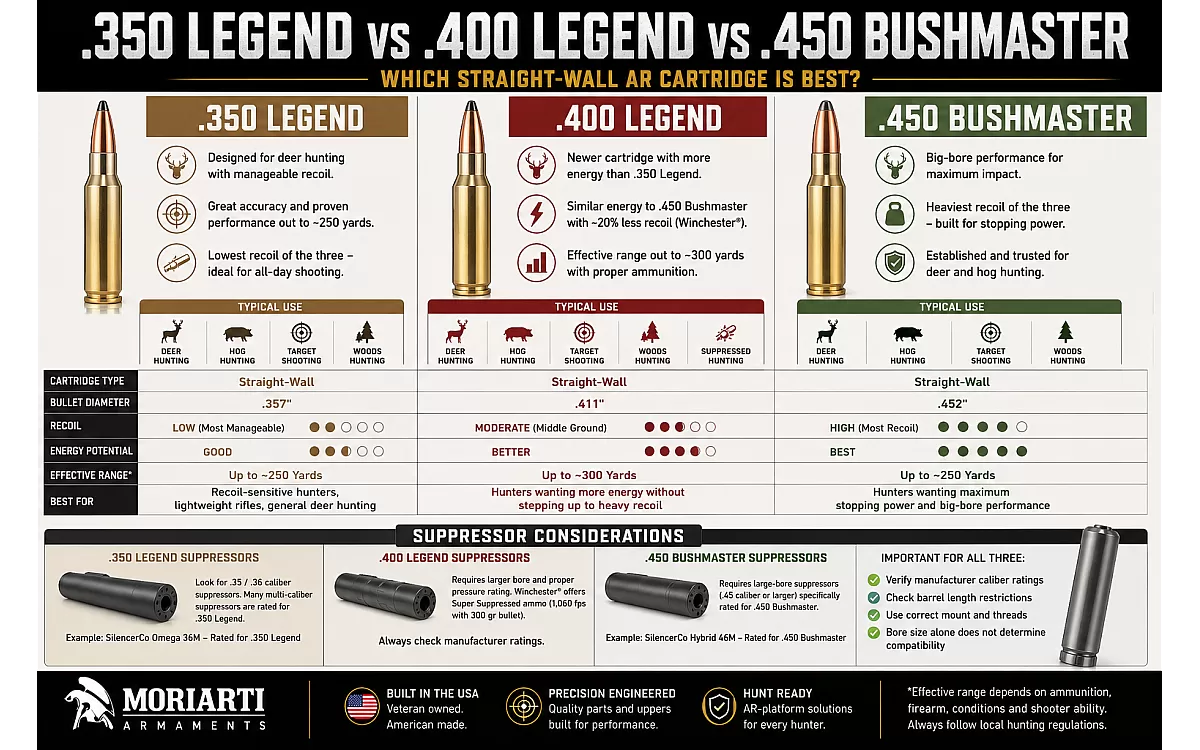
Suppressors are commonly organized by bore/caliber families, including:
.22 / Rimfire
5.7x28mm
5.56 / .223
6mm / .243
6.5mm
6.8mm
.30 Cal
300 Blackout
.338 Cal
8.6 Blackout
9mm
.35 / .36 Cal
.45 Cal / .45 ACP
.458 Cal
.50 Cal
12 Gauge
Always verify the individual suppressor manufacturer's caliber rating, minimum barrel length, pressure limits, mounting requirements and other specifications.
Frequently Asked Questions
What happened to suppressor laws in August 2026?
On August 5, 2026, a federal district court in Texas ruled that specified NFA registration and approval requirements could not constitutionally be enforced against covered parties for relevant firearms whose NFA taxes had been reduced to zero. The resulting injunction took effect on August 13 after its temporary stay expired.
Did the August 2026 ruling remove suppressors from the NFA nationwide?
No. The ruling did not create universal nationwide relief. It prevents enforcement of specified NFA provisions against the plaintiffs and other parties covered by the court's judgment.
Is the $200 suppressor tax gone?
The federal NFA making and transfer tax applicable to suppressors was reduced to $0 effective in 2026. This statutory change is separate from the August court decision.
Do suppressor buyers still need a Form 4?
That depends on whether a transaction falls within the court's injunction and on other applicable federal and state requirements. ATF continues processing Form 4 applications, so buyers should not assume the form has universally disappeared.
Are state suppressor laws affected?
Independent state restrictions remain relevant. The federal district court injunction does not automatically invalidate state suppressor laws.
Can the August suppressor ruling still change?
Yes. Further appeals, stays, court decisions or government guidance could alter the current situation. The litigation should be treated as an active legal development rather than a permanently settled nationwide rule.
The Bottom Line
August 2026 may prove to be a turning point for federal suppressor regulation.
Congress had already reduced the applicable NFA tax to $0. The August 5 federal court decision went substantially further by holding that challenged registration and approval requirements could not continue to be justified under Congress's taxing authority for the covered untaxed firearms.
Then, on August 13, the injunction became effective.
But the most important takeaway is also the simplest:
This is a major suppressor ruling—not a nationwide repeal of every suppressor law.
The decision has limited coverage, other federal requirements can remain applicable, state laws still matter, and further litigation could change the landscape again.
For suppressor buyers and dealers, 2026 is therefore a year to stay informed—and to verify the rules applicable to each transaction rather than relying on yesterday's understanding of the NFA.
Editor's Note — August 25, 2026: This article discusses an actively developing federal court case and is provided for general educational purposes. It is not legal advice. Federal and state requirements should be verified before any suppressor purchase, transfer or possession.