The .400 Legend is one of the newer straight-wall rifle cartridges attracting attention among American hunters. Introduced by Winchester in 2023, it was developed to combine substantial hunting energy with manageable recoil in a cartridge suitable for modern sporting rifles and bolt-action platforms.
But how does the .400 Legend actually perform? Understanding its bullet weight, muzzle velocity, energy retention and trajectory helps explain its growing place in the straight-wall cartridge market.
What Is the .400 Legend?
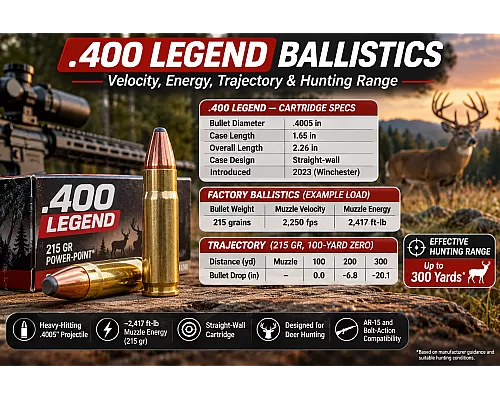
The .400 Legend is a centerfire, straight-wall rifle cartridge developed by Winchester. It uses a nominal .4005-inch diameter projectile and a case measuring approximately 1.65 inches.
Its design reflects the needs of hunters in jurisdictions that permit certain straight-wall cartridges while restricting other rifle ammunition types.
.400 Legend Cartridge Specifications
| Specification | Details |
|---|---|
| Cartridge | .400 Legend |
| Manufacturer | Winchester |
| Introduced | 2023 |
| Case design | Straight-wall |
| Bullet diameter | Approximately .4005 inch |
| Case length | 1.65 inches |
| Maximum overall length | 2.26 inches |
| Example factory load | 215-grain Power-Point |
| Example muzzle velocity | 2,250 fps |
Specifications and example performance figures are based on published cartridge and ammunition information. Actual performance varies by load and firearm.
.400 Legend Ballistics: Understanding Velocity and Energy
One of the most frequently discussed .400 Legend factory loads is Winchester's 215-grain Power-Point.
Published figures place this load at approximately 2,250 feet per second at the muzzle.
Using the standard kinetic-energy calculation, this corresponds to approximately 2,417 foot-pounds of muzzle energy.
| Ballistic measurement | 215-grain Power-Point |
|---|---|
| Bullet weight | 215 grains |
| Muzzle velocity | 2,250 fps |
| Calculated muzzle energy | 2,417 ft-lb |
| Cartridge type | Straight-wall |
These values describe one specific factory load. They should not be treated as universal performance figures for all .400 Legend ammunition.
How Bullet Weight Affects .400 Legend Performance
Bullet weight is only one factor in a cartridge's ballistic performance.
Two projectiles of different weights may produce different velocities, trajectories and retained energy. Bullet shape, construction and ballistic coefficient also influence downrange performance.
The .400 Legend's 215-grain Power-Point is an example of a conventional hunting-oriented load. Other ammunition designs may emphasize different characteristics, including reduced velocity or specialized projectile construction.
When comparing ammunition, it is important to use published data for the exact load rather than assuming all cartridges of the same caliber perform identically.
.400 Legend Trajectory and Bullet Drop
Trajectory describes the curved path a projectile follows after leaving the muzzle.
A bullet begins losing velocity as it travels through the air, while gravity causes its path to drop relative to the line of sight.
For the .400 Legend, trajectory depends on several factors:
The specific factory ammunition
Muzzle velocity
Bullet ballistic coefficient
Sight height and zero distance
Atmospheric conditions
This is why a single universal bullet-drop chart cannot accurately describe every .400 Legend load.
Manufacturer trajectory tables are most useful when they identify the ammunition, test conditions and sight-in assumptions.
.400 Legend Energy Retention
Muzzle energy provides a useful starting point for comparing factory ammunition, but it does not describe how much energy remains farther downrange.
As velocity decreases, kinetic energy also decreases. The rate of that change depends partly on the projectile's aerodynamic characteristics.
Two loads with similar muzzle energy may retain different amounts of energy at the same distance.
For meaningful comparisons, examine the manufacturer's velocity and energy figures at multiple distances, using consistent measurement assumptions.
What Is the Effective Hunting Range of the .400 Legend?
Winchester has positioned the .400 Legend as a hunting cartridge capable of use at distances approaching 300 yards under suitable conditions.
That figure should not be interpreted as a guaranteed effective distance for every load, firearm or hunting situation.
Actual suitability depends on the ammunition manufacturer's intended application, projectile performance, environmental conditions and applicable hunting regulations.
Hunters should consult the ammunition manufacturer's published recommendations and their state wildlife agency before selecting a cartridge for a particular hunting application.
Why Straight-Wall Cartridges Matter
Straight-wall rifle cartridges have become increasingly relevant in American deer hunting because some states and hunting zones regulate permissible cartridges according to case design, projectile diameter, case length or other characteristics.
The .400 Legend is part of a broader family of cartridges developed or adopted for these environments.
However, straight-wall design alone does not guarantee that a cartridge is legal for hunting in every state or season.
Requirements vary by jurisdiction and may change from year to year.
For a broader explanation of how modern straight-wall cartridges compare, read our .350 Legend vs. .400 Legend vs. .450 Bushmaster guide.
Frequently Asked Questions About .400 Legend Ballistics
How fast is a .400 Legend bullet?
Winchester's 215-grain Power-Point factory load has a published muzzle velocity of approximately 2,250 fps. Other loads may differ.
How much muzzle energy does .400 Legend produce?
A 215-grain bullet traveling at 2,250 fps produces approximately 2,417 foot-pounds of kinetic energy at the muzzle.
Is .400 Legend a straight-wall cartridge?
Yes. The .400 Legend was developed as a straight-wall rifle cartridge and introduced in 2023.
What bullet diameter does .400 Legend use?
The cartridge uses a nominal projectile diameter of approximately .4005 inch.
Is .400 Legend suitable for deer hunting?
The cartridge was developed for hunting applications, including deer. Its legal use and the suitability of a particular ammunition load depend on local regulations and manufacturer guidance.
Does .400 Legend have significant bullet drop?
Like every rifle cartridge, the .400 Legend experiences gravitational drop and aerodynamic drag. Exact trajectory figures depend on the particular ammunition and shooting conditions.
Final Thoughts
The .400 Legend illustrates how modern straight-wall cartridge development continues to evolve.
Its combination of a relatively heavy projectile, substantial published muzzle energy and compatibility with multiple rifle platforms has made it an important addition to the straight-wall hunting category.
For anyone researching .400 Legend ballistics, the most valuable approach is to distinguish published factory performance from generalized caliber claims and compare ammunition using consistent, manufacturer-supported data.