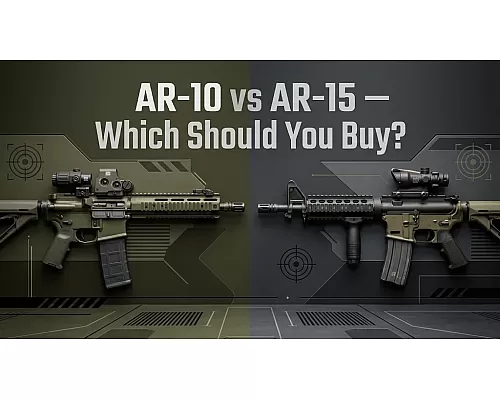
The AR-15 and the AR-10 look almost identical, share the same controls and were both designed by Eugene Stoner. Under the skin they are two different rifles: the AR-15 is a small-frame platform built around intermediate cartridges like 5.56 NATO, while the AR-10 is a large-frame platform built for full-power rifle cartridges like .308 Winchester.
The short answer: choose an AR-15 if you want a light, affordable, low-recoil rifle for home defense, training and shooting inside 400–500 yards. Choose an AR-10 if you want to hunt deer and elk, shoot reliably past 600 yards, or need more energy per shot — and you accept more weight, more recoil and more expensive ammo.
Below we break down the real differences: calibers and ballistics, weight and handling, parts compatibility, cost of ownership and which platform fits which job. We build both platforms at Moriarti Armaments, so we see these trade-offs every day.
AR-10 vs AR-15 at a Glance
| AR-15 (small frame) | AR-10 (large frame) | |
|---|---|---|
| Typical calibers | 5.56 NATO / .223 Rem, .300 Blackout, 6.5 Grendel, 7.62x39, .350/.400 Legend, .450 Bushmaster, 6mm ARC, .338 ARC | .308 Win / 7.62x51, 6.5 Creedmoor, .243 Win, .277 SIG Fury, 8.6 Blackout |
| Muzzle energy (common loads) | about 1,200–1,300 ft-lbs (55 gr 5.56) | about 2,500–2,700 ft-lbs (150 gr .308) |
| Practical range | out to about 400–500 yd | 800 yd and beyond |
| Recoil | light | roughly twice the recoil energy of 5.56 |
| Weight, 16" carbine (unloaded) | about 6–7.5 lb | about 8–10 lb |
| Magazine | standard AR-15 (STANAG) | SR-25 / Magpul pattern (DPMS-style) |
| Ammo cost per round | lowest of any centerfire rifle | about twice the cost of 5.56 |
| Best for | home defense, training, competition, varmints | deer/elk hunting, long range, precision |
Figures are typical values for common factory loads and builds; exact numbers vary by barrel length, load and configuration.
Calibers, Ballistics and Recoil
The biggest difference between the two platforms is the cartridge they are built around. Everything else — frame size, weight, price — follows from it.
AR-15: intermediate cartridges
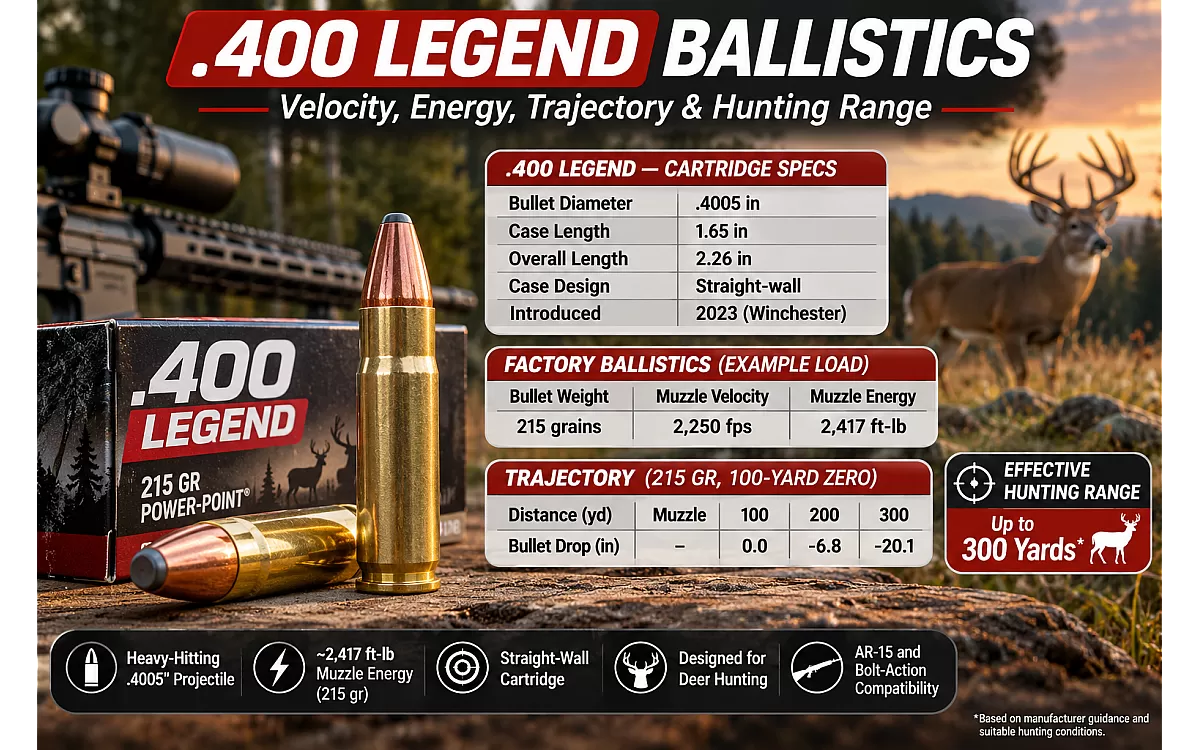
The AR-15 is sized for cartridges with an overall length of about 2.26 inches. The classic 5.56 NATO / .223 Remington is fast, flat-shooting and easy to control, which is why it dominates home defense, training and 3-gun. The AR-15 is also the most versatile platform in America: with a simple upper swap you can run .300 Blackout for suppressed shooting, 6.5 Grendel or 6mm ARC for longer range, or big-bore rounds like .350 Legend, .400 Legend and .450 Bushmaster for straight-wall deer states.
AR-10: full-power rifle cartridges
The AR-10 uses a larger receiver to handle cartridges around 2.8 inches long. .308 Winchester / 7.62x51 delivers roughly twice the muzzle energy of 5.56 and keeps that energy much farther downrange, which matters for clean, ethical kills on deer, hogs and elk. The same frame runs 6.5 Creedmoor (lower recoil, excellent long-range ballistics), .243 Win for varmint-to-deer use, and the newer .277 SIG Fury and 8.6 Blackout. Not sure between the two most popular AR-10 rounds? Read our 6.5 Creedmoor vs .308 comparison.
Recoil and follow-up shots
A 5.56 AR-15 has very mild recoil, so newer shooters, smaller-framed shooters and anyone running fast drills will shoot it more accurately. A .308 AR-10 kicks noticeably harder — a good muzzle brake, an adjustable gas block and the extra rifle weight tame it, but it will never feel like an AR-15. 6.5 Creedmoor is the softest-shooting common AR-10 option.
Hunting rules
Many states set minimum caliber or energy rules for big game, and some restrict .22-caliber centerfire rounds for deer. A .308 or 6.5 Creedmoor AR-10 is legal for deer and elk almost everywhere; for an AR-15, check your state's rules or choose a hunting caliber like 6.5 Grendel, .350 Legend or .450 Bushmaster. Always confirm current state regulations before the season.
Weight, Size and Handling
An AR-10 is not just an AR-15 with a bigger barrel. The upper and lower receivers, bolt carrier group, barrel extension and magazine well are all larger and heavier. A typical 16" AR-15 carbine weighs about 6–7.5 lb unloaded; a comparable AR-10 is about 8–10 lb before optics, and a 20–24" precision AR-10 can top 11–12 lb with a scope.
That extra weight is a trade-off. It makes an AR-10 steadier on a bipod and softer to shoot, but heavier to carry on an all-day hunt and slower to move indoors. For home defense, vehicle carry or a truck gun, the lighter, shorter AR-15 is the easier rifle to live with.
Pistols and micro builds
Both platforms come in pistol and short-barrel configurations. Short AR-15 pistols — like our Micro ARP line in 5.56, .300 Blackout and 10mm — are compact, light and easy to suppress. Large-frame pistols with 7.5"–12.5" barrels have become popular too; see the rise of the micro AR-10 for why. Expect a big muzzle blast and plenty of recoil from a short .308, so a quality brake or a suppressor is worth budgeting for. Short-barreled rifles (SBRs) of either platform are NFA items — check federal and state rules before you buy.
Parts Compatibility: What Swaps and What Doesn't
If you already own an AR-15, many small parts and accessories carry over to an AR-10. The core parts do not.
| Part | Interchangeable AR-15 ↔ AR-10? |
|---|---|
| Trigger / fire control group | Usually yes (mil-spec pattern) |
| Pistol grip, safety selector | Usually yes |
| Carbine buffer tube and stocks | Usually yes (buffer weight and spring are different) |
| Optics, lights, slings | Yes |
| Upper receiver, barrel, handguard | No |
| Bolt carrier group | No |
| Magazines | No |
| Lower receiver | No |
DPMS vs Armalite pattern AR-10s
Unlike the AR-15, the AR-10 has no single standard. The two main patterns are DPMS / LR-308 style (the most common, using SR-25 / Magpul-pattern magazines) and the Armalite AR-10 pattern, with different receiver dimensions, handguards and magazines. DPMS "high-profile" and "low-profile" upper receivers also differ. Before buying an AR-10 upper, barrel or handguard, make sure it matches your lower. Moriarti AR-10 parts are DPMS-compatible — see our AR-10 .308 compatibility chart and the full AR-15 and AR-10 compatibility guide.
Cost of Ownership
AR-15s are cheaper to buy, cheaper to feed and cheaper to upgrade. Parts are made by hundreds of manufacturers, so prices are competitive and everything is in stock. AR-10 rifles and parts cost more because they use more material and have a smaller market. The bigger long-term cost is ammunition: .308 and 6.5 Creedmoor typically cost about twice as much per round as 5.56, so a 500-round range season costs noticeably more.
A smart way to control cost on either platform is to buy a complete upper assembly for a lower you already own, or start from a build kit and assemble it yourself.
Which One Should You Choose?
| Your main use | Our pick | Why |
|---|---|---|
| Home defense | AR-15 (5.56 or .300 BLK) | Light, short, low recoil, fast follow-up shots |
| First rifle / training | AR-15 (5.56) | Cheapest ammo, easiest to learn on |
| Deer, hog and elk hunting | AR-10 (.308 or 6.5 CM) | More energy at distance; legal almost everywhere |
| Long range, 600–1,000 yd | AR-10 (6.5 Creedmoor) | Flat trajectory, wind resistance, mild recoil for its class |
| Suppressed shooting | AR-15 (.300 Blackout) | Subsonic loads, short barrels cycle well |
| Straight-wall-cartridge deer states | AR-15 (.350/.400 Legend, .450 BM) | Big-bore power on the light AR-15 frame |
| One rifle that does it all | AR-15 with a spare upper | Swap calibers in seconds on one lower |
Many shooters end up owning both: an AR-15 for defense and training, and an AR-10 for hunting season and long range.
Moriarti AR-15 and AR-10 Options
- AR-15 line: complete rifles, pistols, uppers and kits in 5.56, .300 Blackout, 6.5 Grendel, .350 Legend, .400 Legend, .450 Bushmaster and more — shop the AR-15 line.
- AR-10 line: DPMS-compatible .308, 6.5 Creedmoor, .243 and .277 SIG Fury uppers, rifle kits and large-frame pistols — shop the AR-10 line.
- Complete Moriarti firearms: rifles and pistols built and test-fired in-house.
AR-10 vs AR-15: FAQ
Is an AR-10 more powerful than an AR-15?
Yes. A .308 AR-10 produces roughly twice the muzzle energy of a 5.56 AR-15 and holds its energy much farther downrange.
Can I put an AR-10 upper on an AR-15 lower?
No. The receivers are different sizes. You need a matching AR-10 lower, and the upper and lower must be the same pattern (DPMS or Armalite).
Is an AR-10 good for home defense?
It works, but most people are better served by an AR-15: it is lighter, shorter and has less recoil and less over-penetration than .308.
Do AR-15 magazines fit an AR-10?
No. DPMS-pattern AR-10s use SR-25 / Magpul-pattern .308 magazines; Armalite AR-10s use their own magazines.
Which is more accurate?
Both can be very accurate. Accuracy depends more on the barrel, ammunition and shooter than on the platform. The AR-10’s cartridges simply stay accurate and powerful at longer distances.
Can an AR-15 hunt deer?
Yes, in many states — especially with 6.5 Grendel, .350 Legend, .400 Legend or .450 Bushmaster. Some states restrict .22-caliber centerfire rounds for big game, so check local rules.
Bottom Line
Buy an AR-15 if you want the lightest, cheapest and most versatile rifle for defense, training and medium-range shooting. Buy an AR-10 if hunting big game or reaching past 600 yards matters most. Questions about which configuration fits you? Contact our team — we build both platforms and will help you choose.