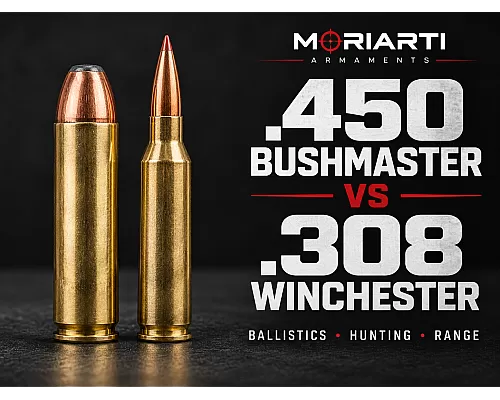
The .450 Bushmaster and .308 Winchester are two well-established hunting cartridges, but they approach rifle performance in very different ways. One emphasizes a large-diameter bullet and relatively short-range hunting applications; the other combines a streamlined bottleneck cartridge with a broader effective-range envelope.
Although both can be chambered in semiautomatic sporting rifles, they are not interchangeable and generally belong to different AR-platform sizes.
For hunters comparing .450 Bushmaster vs. .308 Winchester, the key questions are how each cartridge performs at distance, how its bullet construction affects hunting applications, and which platform and ammunition options are available.
What Is .450 Bushmaster?
The .450 Bushmaster is a large-bore, straight-wall rifle cartridge developed to provide substantial bullet diameter in an AR-15-size platform. Its .452-inch-diameter bullets are considerably wider than the .308-inch projectiles used in .308 Winchester.
Common factory loads use projectiles around 250 to 300 grains, although other weights are available. The cartridge is especially associated with deer and hog hunting and with jurisdictions that permit qualifying straight-wall cartridges during particular hunting seasons.
A typical Hornady 250-grain FTX factory load is listed at approximately 2,200 feet per second from a 20-inch test barrel, producing about 2,687 foot-pounds of muzzle energy.
What Is .308 Winchester?
Introduced commercially in the early 1950s, .308 Winchester is a bottleneck centerfire rifle cartridge with a long history in hunting, competition and recreational target shooting.
Factory ammunition commonly includes 125-, 150-, 165- and 180-grain projectiles, along with additional specialized bullet weights.
The cartridge is widely available in bolt-action rifles and AR-10-size semiautomatic platforms. Its aerodynamic projectiles and broad ammunition selection make it useful across a greater variety of distances than .450 Bushmaster.
.450 Bushmaster vs. .308 Winchester: Key Specifications
Feature | .450 Bushmaster | .308 Winchester |
|---|---|---|
Cartridge design | Straight-wall | Bottleneck |
Bullet diameter | .452 in | .308 in |
Common hunting bullet weights | 250–300 gr | 150–180 gr |
Typical AR platform | AR-15-size | AR-10-size |
General hunting emphasis | Short- to medium-range | Medium- to longer-range |
Long-range trajectory | More pronounced drop | Generally flatter |
Ammunition selection | More specialized | Broadly available |
These are general comparisons. Individual loads, barrel lengths and projectile designs can produce substantially different results.
Ballistics Comparison: Velocity and Energy
Ballistic performance depends on bullet weight, muzzle velocity, projectile design and aerodynamic drag.
A heavier bullet does not automatically produce greater downrange energy, and a faster projectile does not necessarily perform better in every hunting application.
Hornady's published ballistics for a 250-grain .450 Bushmaster FTX load illustrate how velocity and energy decline as distance increases.
Distance | .450 Bushmaster velocity | .450 Bushmaster energy |
|---|---|---|
Muzzle | 2,200 fps | 2,687 ft-lb |
100 yards | 1,835 fps | 1,868 ft-lb |
200 yards | 1,515 fps | 1,274 ft-lb |
300 yards | 1,255 fps | 874 ft-lb |
Hornady 250-grain FTX factory data from a 20-inch test barrel. Figures are load-specific, not universal .450 Bushmaster performance.
By comparison, many .308 Winchester hunting loads launch lighter, more aerodynamic bullets at higher velocities. Their streamlined profiles generally retain velocity more efficiently over longer distances.
That difference becomes especially noticeable as range increases.
Which Cartridge Has the Flatter Trajectory?
.308 Winchester generally has the flatter trajectory, particularly beyond typical short-range hunting distances.
The reason is not simply muzzle velocity. Bullet shape and ballistic coefficient play major roles in determining how rapidly a projectile loses speed.
The larger, relatively blunt bullets commonly used in .450 Bushmaster tend to experience greater aerodynamic drag than streamlined .308 hunting projectiles.
For hunters working in dense woodland or relatively short-range conditions, the trajectory difference may be manageable. Across open fields and longer distances, .308 Winchester offers a more forgiving ballistic profile.
Effective Range: .450 Bushmaster vs. .308
The effective range of any hunting cartridge depends on the specific ammunition, target, environmental conditions and shooter.
.450 Bushmaster is commonly associated with hunting at shorter distances, often around 200 yards or less depending on the load and conditions. Its trajectory becomes increasingly steep beyond that range.
.308 Winchester is capable of considerably longer-range performance with appropriate ammunition and equipment. Its streamlined bullets retain velocity and energy more efficiently, although practical hunting distance remains limited by shot placement, terminal-performance requirements and conditions.
Neither cartridge has one universally applicable maximum effective hunting range.
Hunting Applications
Deer Hunting
Both cartridges are used for deer hunting.
.450 Bushmaster is particularly relevant in jurisdictions that authorize qualifying straight-wall cartridges, while .308 Winchester has long been used for deer hunting across a broad range of environments.
Hunters should verify current state-specific rules, including cartridge dimensions, permitted firearms and hunting-season restrictions.
Hog Hunting
Both .450 Bushmaster and .308 Winchester are used for feral hog hunting.
The .450 Bushmaster's large bullet diameter and suitable expanding hunting projectiles make it an established option at moderate distances.
.308 Winchester provides a broader selection of hunting ammunition and generally better downrange ballistic efficiency.
Open Terrain vs. Wooded Terrain
The contrast is clearest when considering distance.
In wooded environments where shots are typically closer, .450 Bushmaster's characteristics can be well suited to the application.
In open terrain where longer shots may occur, .308 Winchester's flatter trajectory and greater ballistic efficiency become more relevant.
Recoil Comparison
Both cartridges produce noticeable recoil, but recoil cannot be determined from caliber alone.
Rifle weight, stock geometry, ammunition, muzzle devices and operating system all influence felt recoil.
A relatively lightweight .450 Bushmaster rifle can produce substantial recoil with heavy factory ammunition. A heavier .308 Winchester rifle may feel different despite using a high-energy cartridge.
Direct recoil comparisons should account for rifle weight and the specific loads being evaluated.
AR-15 vs. AR-10 Platform Differences
An important distinction is the size of the rifle platform.
The .450 Bushmaster is designed for compatible AR-15-size firearms. By contrast, .308 Winchester generally requires a larger AR-10-size action because of its cartridge dimensions.
These differences affect receiver geometry, magazine compatibility and other firearm components.
The cartridges cannot be used interchangeably, and sharing a general AR-style appearance does not establish compatibility.
For broader background on these platforms, read Moriarti's existing guide to AR-15 and AR-10 platform compatibility and differences.
Ammunition Availability
.308 Winchester has a significant advantage in overall ammunition selection. It is produced by numerous manufacturers in a wide range of hunting, target and specialty configurations.
.450 Bushmaster ammunition is available from established manufacturers, including Hornady, Federal and Winchester, but its selection is more specialized.
Availability and pricing vary over time, so current manufacturer catalogs and local availability are more useful than fixed assumptions.
Frequently Asked Questions
Is .450 Bushmaster more powerful than .308 Winchester?
Not universally. Certain .450 Bushmaster loads produce substantial muzzle energy, but .308 Winchester generally retains velocity and energy more efficiently at longer distances. A meaningful comparison requires specific factory loads.
Is .450 Bushmaster better than .308 for deer hunting?
Both are established deer-hunting cartridges. The choice depends on hunting distance, local regulations, ammunition selection and the intended application.
Does .450 Bushmaster shoot flatter than .308?
Generally, no. .308 Winchester typically offers a flatter trajectory with conventional hunting loads, especially as distance increases.
Can .450 Bushmaster be used in an AR-15?
Yes, in firearms specifically chambered and configured for .450 Bushmaster. It is not compatible with an ordinary .223 Remington or 5.56 NATO chamber.
Can .308 Winchester be used in an AR-15?
Not in a conventional AR-15-size action. .308 Winchester is commonly chambered in larger AR-10-size rifles and bolt-action firearms.
Is .450 Bushmaster a straight-wall cartridge?
Yes. .450 Bushmaster has a straight-wall case design, but hunting legality depends on each jurisdiction's current regulations.
Final Thoughts
The .450 Bushmaster vs. .308 Winchester comparison highlights two distinct approaches to hunting-rifle performance.
.450 Bushmaster offers a large-diameter projectile in an AR-15-size platform and is particularly relevant to shorter-range hunting and certain straight-wall hunting regulations.
.308 Winchester offers broader ammunition availability, generally flatter trajectories and more efficient performance across longer distances.
Understanding those differences helps shooters evaluate the cartridges according to their intended sporting application rather than assuming that one is superior in every situation.
Explore additional cartridge information in Moriarti's rifle caliber guides and educational articles.