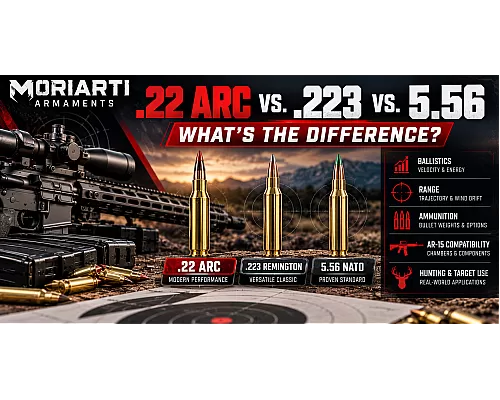
The AR-15 platform has evolved far beyond its traditional 5.56 NATO chambering. One of the most interesting additions is .22 ARC (Advanced Rifle Cartridge), a modern .22-caliber cartridge developed by Hornady to deliver impressive long-range performance from the compact AR-15 platform.
But how does .22 ARC compare to the established .223 Remington and 5.56 NATO cartridges?
All three use .224-inch-diameter projectiles, yet their cartridge designs, ammunition options, ballistic characteristics and chamber requirements are not identical.
Whether you're comparing long-range target performance, varmint hunting, ammunition availability or AR-15 platform compatibility, understanding these differences is essential.
What Is .22 ARC?
The .22 ARC, introduced by Hornady for 2024, is a centerfire rifle cartridge developed specifically around modern, high-ballistic-coefficient .22-caliber bullets.
Unlike .223 Remington and 5.56 NATO, which originated decades earlier, .22 ARC was designed with contemporary projectile technology in mind.
Its defining characteristics include:
A cartridge design intended for AR-15-length actions.
Factory ammunition with bullet weights reaching 88 grains.
A chamber and cartridge developed together for consistent performance.
A 1:7-inch twist rate in Hornady's standard platform specifications.
High-BC projectiles designed to retain velocity and resist wind drift over longer distances.
Hornady developed the cartridge using design principles established with the 6mm ARC, bringing a different approach to .22-caliber AR-15 performance.
For shooters interested in long-range target shooting or varmint and predator applications, .22 ARC offers a modern alternative to conventional .223 Remington and 5.56 NATO ammunition.
.22 ARC vs. .223 Remington vs. 5.56 NATO: Key Differences
Although these cartridges share the same nominal bullet diameter, their designs and typical applications differ considerably.
Feature | .22 ARC | .223 Remington | 5.56 NATO |
|---|---|---|---|
Bullet diameter | .224" | .224" | .224" |
Platform | AR-15, bolt action | AR-15, bolt action | AR-15, military-style rifles |
Common bullet weights | 62–88 gr factory offerings | 40–77 gr, among others | 55–77 gr, among others |
Primary emphasis | High-BC, extended-range performance | Versatility, hunting, target shooting | General-purpose rifle use |
Typical barrel twist | 1:7" in Hornady specification | Varies by firearm | Commonly 1:7" or 1:9" |
Ammunition availability | Specialized, growing | Extensive | Extensive |
Interchangeable with .22 ARC? | No | No | No |
The biggest distinction isn't simply bullet diameter or muzzle velocity.
.22 ARC was designed to accommodate heavier, aerodynamically efficient projectiles in the AR-15 platform, while .223 Remington and 5.56 NATO offer a much larger established ammunition and firearm ecosystem.
.22 ARC Ballistics: Why Bullet Design Matters
Ballistic performance involves much more than how quickly a bullet leaves the barrel.
Three important factors influence downrange performance:
Muzzle velocity determines the projectile's initial speed.
Ballistic coefficient (BC) describes how efficiently a projectile overcomes aerodynamic drag.
Bullet weight and construction influence how the projectile retains momentum and performs for its intended application.
Traditional .223 Remington and 5.56 NATO ammunition often emphasizes lighter projectiles at relatively high muzzle velocities.
By comparison, .22 ARC was developed to make effective use of heavier .22-caliber bullets with high ballistic coefficients.
A projectile with a higher BC can retain velocity more efficiently and experience less wind drift under comparable conditions.
That advantage becomes increasingly relevant as distance increases.
Hornady .22 ARC Factory Ammunition
Hornady's .22 ARC lineup includes several distinct factory offerings:
Bullet weight | Hornady projectile | Ammunition line |
|---|---|---|
62 gr | ELD-VT | V-Match |
70 gr | CX | Superformance |
75 gr | ELD Match | BLACK |
80 gr | ELD-X | Precision Hunter |
88 gr | ELD Match | Match |
These loads demonstrate the cartridge's versatility, ranging from lightweight varmint-oriented projectiles to heavier match bullets.
The 88-grain ELD Match is particularly noteworthy because it illustrates the heavy-for-caliber projectile design that helped distinguish .22 ARC from conventional .223 and 5.56 ammunition.
For current ammunition specifications, see Hornady's official .22 ARC information.
.22 ARC vs. .223 Remington: Which Has Better Long-Range Ballistics?
For many shooters, this is the central question.
A conventional .223 Remington load may achieve higher initial velocity than a heavier .22 ARC load, depending on the ammunition and barrel lengths being compared.
However, muzzle velocity alone does not determine long-range performance.
The heavier, high-BC bullets available in .22 ARC can retain velocity more efficiently as they travel downrange.
That can translate into meaningful differences in wind drift and trajectory, particularly when comparing projectiles with substantially different ballistic coefficients.
For example, Hornady lists its 88-grain .22-caliber ELD Match projectile with a G1 ballistic coefficient of approximately 0.545 at higher velocities.
That is substantially different from the aerodynamic characteristics of many conventional 55-grain .223 projectiles.
The comparison becomes more nuanced when .22 ARC is evaluated against modern .223 match ammunition using heavy, high-BC bullets.
A properly matched .223 Remington target load can still deliver excellent long-range accuracy.
The advantage of .22 ARC is its purpose-built cartridge architecture for accommodating heavy, aerodynamic .22-caliber projectiles within the AR-15 platform.
.22 ARC vs. 5.56 NATO: What's Different?
5.56 NATO remains one of the most widely used rifle cartridges in the United States.
Its advantages include broad ammunition availability, established firearm compatibility and a wide selection of factory loads.
For general-purpose recreational shooting, training and many practical applications, 5.56 NATO remains a familiar and versatile choice.
.22 ARC takes a different approach.
Rather than emphasizing broad standardization and ammunition commonality, the cartridge focuses on modern projectile design and extended-range ballistic efficiency.
This distinction matters most when comparing ammunition designed for different purposes.
A 55-grain 5.56 NATO load and an 88-grain .22 ARC match load are not direct equivalents.
One emphasizes a lighter projectile, while the other emphasizes a heavier projectile with greater aerodynamic efficiency.
Neither cartridge is universally superior across every shooting application.
Does .22 ARC Have Less Wind Drift Than .223 or 5.56?
Potentially, yes—particularly when comparing heavy, high-BC .22 ARC bullets against conventional lighter .223 Remington or 5.56 NATO projectiles.
Wind drift depends on several variables, including:
Projectile ballistic coefficient
Muzzle velocity
Distance
Wind speed and direction
Atmospheric conditions
A high-BC projectile generally retains velocity more efficiently and can spend less time in flight over a given distance than a lower-BC projectile launched under otherwise comparable conditions.
That can reduce wind drift.
However, a precise comparison requires evaluating specific factory loads using consistent barrel lengths and environmental conditions.
It would be misleading to claim that every .22 ARC load experiences less wind drift than every .223 Remington or 5.56 NATO load.
How Far Can a .22 ARC Shoot?
.22 ARC was developed with extended-range performance in mind.
Its heavy, high-BC factory projectiles make it especially relevant to long-range target shooting.
But there is an important difference between a cartridge's maximum travel distance, its practical target-shooting capability and its effective hunting range.
For target shooting, practical distance depends on the firearm, ammunition, environmental conditions and the shooter's ability.
For hunting, projectile construction, terminal performance and the requirements of the intended game are additional considerations.
The cartridge's ballistic efficiency makes it attractive for applications where retained velocity and wind resistance matter.
It does not establish one universal effective-range figure for every .22 ARC firearm or load.
Is .22 ARC Good for Varmint and Predator Hunting?
.22 ARC offers several characteristics that make it appealing for varmint and predator hunting.
Hornady's factory ammunition lineup includes the 62-grain ELD-VT and 70-grain CX, along with the 80-grain ELD-X Precision Hunter offering.
These projectiles serve different purposes, and their construction should be considered when selecting ammunition for a particular hunting application.
The cartridge's ability to use aerodynamic projectiles also makes it interesting in open terrain, where wind can become a significant factor.
As with any hunting cartridge, ammunition selection should account for the intended game, applicable hunting regulations and the projectile manufacturer's recommendations.
AR-15 Compatibility: Can You Use .22 ARC in a .223 or 5.56 Rifle?
No. .22 ARC ammunition is not interchangeable with .223 Remington or 5.56 NATO ammunition.
Although all three cartridges use .224-inch-diameter projectiles, their cartridge cases and chamber dimensions differ.
A firearm chambered for .223 Remington or 5.56 NATO should not be used with .22 ARC ammunition.
Likewise, a .22 ARC chamber is not designed for .223 Remington or 5.56 NATO ammunition.
Sharing the AR-15 platform does not make the cartridges interchangeable.
Firearm and ammunition compatibility must always be determined by the manufacturer's specifications and the firearm's designated chambering.
What About .223 Remington and 5.56 NATO Compatibility?
These two cartridges are much more closely related, but chamber markings still matter.
According to the Sporting Arms and Ammunition Manufacturers' Institute (SAAMI), .223 Remington ammunition can be used in a firearm with a verified military-specification 5.56 chamber.
However, SAAMI advises against firing 5.56 NATO ammunition in a barrel marked only for .223 Remington because differences in chamber geometry can create unsafe pressure conditions.
Always follow the firearm manufacturer's instructions and chamber markings.
For additional guidance, see SAAMI's official ammunition compatibility FAQs.
.22 ARC vs. .223 vs. 5.56: Ammunition Availability
One area where .223 Remington and 5.56 NATO retain a clear advantage is ammunition availability.
Both cartridges benefit from decades of widespread commercial use.
They are available from numerous manufacturers in a broad range of bullet weights, projectile types and ammunition lines.
.22 ARC is a newer cartridge with a more specialized factory ammunition ecosystem.
Hornady offers several distinct .22 ARC loads, but the market remains less extensive than the established .223 and 5.56 categories.
For shooters who prioritize broad ammunition availability, that difference may be significant.
For shooters specifically interested in the cartridge's high-BC projectile offerings, the specialized .22 ARC lineup provides a different set of choices.
Which Cartridge Makes the Most Sense?
The answer depends on the intended application.
.22 ARC stands out for shooters interested in modern high-BC .22-caliber projectiles, long-range target performance and specialized varmint or predator applications.
.223 Remington remains an established option for recreational shooting, target applications and hunting where appropriate.
5.56 NATO offers broad ammunition availability and an extensive ecosystem of compatible firearms and factory ammunition.
Each cartridge serves a distinct purpose, and choosing between them requires more than comparing bullet diameter or muzzle velocity.
Frequently Asked Questions
Is .22 ARC better than .223 Remington?
.22 ARC offers advantages for certain long-range applications because it was designed around heavy, high-ballistic-coefficient projectiles. .223 Remington remains more widely available and highly versatile. Neither is universally better.
Is .22 ARC the same as 5.56 NATO?
No. .22 ARC and 5.56 NATO are different cartridges with different chamber and case dimensions. They are not interchangeable.
What bullet weights are available for .22 ARC?
Hornady lists factory .22 ARC loads using 62-, 70-, 75-, 80- and 88-grain projectiles.
Does .22 ARC fit the AR-15 platform?
Yes. .22 ARC was developed for the AR-15-size platform and is also available in compatible bolt-action firearms. It requires a firearm specifically chambered and configured for .22 ARC.
Is .22 ARC good for long-range shooting?
Yes. Its heavy, high-BC projectile options were developed with extended-range ballistic performance in mind. Actual accuracy and effective range depend on the specific firearm, ammunition and conditions.
Is .22 ARC faster than .223 Remington?
Not necessarily. Muzzle velocity depends on the specific ammunition and barrel length. The advantage of .22 ARC is not simply higher initial velocity; it is the ability to use heavier, aerodynamically efficient projectiles.
Can you shoot .22 ARC through a .223 or 5.56 barrel?
No. .22 ARC requires a chamber specifically designed for that cartridge. Similar bullet diameter does not establish ammunition compatibility.
Final Thoughts: Is .22 ARC the Future of .22-Caliber AR Performance?
The introduction of .22 ARC demonstrates how modern cartridge development continues expanding the capabilities of the AR-15 platform.
While .223 Remington and 5.56 NATO remain firmly established, .22 ARC brings a different design philosophy centered on heavy, aerodynamic projectiles and extended-range performance.
Its factory ammunition lineup, modern chamber design and compatibility with the AR-15-size platform make it an important cartridge for shooters researching the next generation of .22-caliber rifle ammunition.
For those comparing these three cartridges, the most important distinction is straightforward:
.223 Remington and 5.56 NATO offer established versatility. .22 ARC introduces a purpose-built approach to high-BC .22-caliber performance.
Explore more firearm caliber comparisons, AR-platform information and emerging cartridge coverage in the Moriarti Armaments Blog.