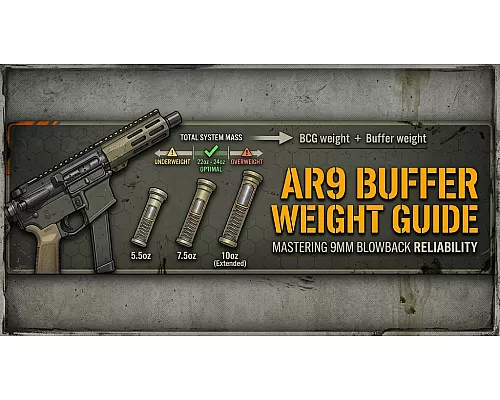
Choosing the right AR-9 buffer weight is one of the most important parts of setting up a reliable and comfortable 9mm pistol-caliber carbine. Unlike a traditional gas-operated AR-15, many AR-9 platforms use a straight-blowback operating system that relies heavily on bolt mass, buffer weight, and spring resistance to control movement of the action.
A buffer that is poorly matched to the bolt and operating system may contribute to harsh recoil, excessive bolt speed, bolt bounce, unnecessary wear, feeding problems, or inconsistent last-round bolt hold open. At the same time, simply installing the heaviest buffer available is not always the correct solution.
This guide explains how AR-9 buffers work, why extended 9mm buffers are commonly used, how different buffer weights affect cycling, and how to choose between standard, heavy, dead-blow, and hydraulic buffer designs.
Quick Answer: What Buffer Weight Is Best for an AR-9?
For many traditional straight-blowback AR-9 platforms, an extended 9mm buffer weighing approximately 7.5 to 10 ounces is a common starting range. The ideal choice depends on the bolt carrier group, ammunition, spring, barrel configuration, suppressor use, and manufacturer requirements.
| AR-9 Configuration | Common Buffer Approach |
|---|---|
| Traditional straight-blowback AR-9 | Extended heavy 9mm buffer |
| General-purpose range build | Approximately 7.5–8.5 oz extended buffer |
| Harsh or fast-cycling blowback system | Heavier dead-blow or hydraulic option may help |
| Competition PCC | Tuned system based on bolt mass, spring and ammunition |
| Radial-delayed or other delayed system | Follow the operating-system manufacturer’s specifications |
| Bufferless PCC | Traditional buffer guidance does not apply |
Important: Do not choose a buffer by weight alone. The operating system must be identified first. Advice intended for a straight-blowback AR-9 may be incorrect for a radial-delayed, roller-delayed, gas-operated, or bufferless PCC.
What Does the Buffer Do in an AR-9?
In a traditional straight-blowback AR-9, the action is not locked in the same way as a gas-operated AR-15. Instead, the mass of the bolt and buffer, along with spring resistance, helps delay rearward movement long enough for chamber pressure to fall.
The buffer also helps:
- Control rearward bolt speed
- Absorb impact at the rear of the buffer tube
- Return the bolt forward
- Reduce excessive action movement
- Limit bolt overtravel
- Reduce bolt bounce when the correct design is used
- Influence felt recoil and muzzle movement
Because the AR-9 bolt is normally heavier than a standard AR-15 bolt, the buffer system must be selected as part of the complete operating system rather than treated as an isolated component.
Why AR-9 Buffers Are Heavier Than Standard AR-15 Buffers
A typical gas-operated AR-15 uses gas pressure to unlock and cycle the bolt carrier. In a straight-blowback 9mm AR, there is no rotating, gas-unlocked bolt performing the same delay function.
The straight-blowback system therefore relies more heavily on reciprocating mass and spring resistance. A heavier buffer can slow the action and reduce how violently the bolt reaches the rear of the receiver extension.
A buffer that is too light may allow the bolt to move too quickly, potentially creating:
- Sharp or harsh recoil
- Increased muzzle movement
- Excessive bolt speed
- Accelerated component wear
- Damage to the bolt catch from excess overtravel
- Bolt bounce
- Inconsistent feeding or extraction
However, excessive buffer weight or spring resistance can also create problems if the bolt can no longer travel far enough or fast enough to complete the full operating cycle.
Why Extended 9mm Buffers Are Commonly Used
Many AR-9 bolts are shorter than a standard AR-15 bolt carrier group. When a standard-length carbine buffer is used without the correct spacer or system design, the bolt may travel farther rearward than necessary.
An extended 9mm buffer takes up additional space inside the receiver extension and helps limit bolt overtravel.
Potential benefits include:
- Reduced bolt-catch impact
- Shorter and more controlled bolt travel
- More consistent cycling
- Less unnecessary movement of the reciprocating assembly
- No separate rear spacer required in many configurations
Extended buffers are available in different weights and internal designs, including solid, sliding-weight, dead-blow, and hydraulic versions.
Common AR-9 Buffer Weight Ranges
There is no universal buffer weight that works in every AR-9. The following ranges are general categories rather than guaranteed recommendations.
| Approximate Buffer Weight | General Characteristics |
|---|---|
| Under 6 oz | Often light for traditional straight-blowback systems unless specifically required by the manufacturer |
| Approximately 6–7.5 oz | May work in lighter or specially configured systems |
| Approximately 7.5–8.5 oz | Common general-purpose range for many straight-blowback AR-9 builds |
| Approximately 8.5–10 oz | Heavier option that may slow the action and soften harsh cycling |
| Over 10 oz | Specialized tuning range; compatibility must be verified carefully |
The correct choice depends on the combined mass and behavior of the bolt, buffer, spring, ammunition, and complete firearm.
Buffer Weight and Bolt Mass Work Together
The buffer does not operate independently from the bolt. Two AR-9 builds using the same buffer may behave differently if their bolt carrier groups have different weights.
When evaluating the system, consider:
- Bolt carrier group weight
- Buffer weight
- Buffer length
- Spring type and resistance
- Ammunition pressure and bullet weight
- Barrel length
- Suppressor use
- Magazine and lower-receiver design
- Whether the action is straight blowback or delayed blowback
A relatively light bolt paired with a light buffer may cycle much faster than a heavier combination. Conversely, an excessively heavy system may fail to travel far enough to eject, feed, or lock open reliably.
Solid vs Dead-Blow AR-9 Buffers
Solid Buffer
A solid buffer uses a one-piece internal mass. It is simple and durable, but it may transfer more of the action’s impact directly through the system.
Advantages may include:
- Simple construction
- Consistent fixed weight
- Durability
- Lower cost
Dead-Blow or Sliding-Weight Buffer
A dead-blow buffer contains moving internal weights or shot. As the bolt closes, the internal mass continues moving briefly, helping resist rebound.
This design may help reduce:
- Bolt bounce
- Harsh closing impact
- Inconsistent ignition caused by bolt rebound
- Excessive movement during rapid shooting
For many traditional blowback systems, a properly selected dead-blow buffer can provide a smoother operating feel than a solid buffer of similar total weight.
What Is Bolt Bounce?
Bolt bounce occurs when the bolt closes and then rebounds slightly instead of remaining fully seated. It is most commonly associated with heavy reciprocating assemblies moving quickly inside blowback-operated firearms.
Possible signs may include:
- Intermittent failures to fire
- Light primer strikes
- Problems that occur more often during rapid shooting
- Inconsistent operation despite normal feeding
A dead-blow buffer with moving internal mass can help counter this rebound. Bolt bounce can also be influenced by bolt design, spring choice, ammunition, and overall system timing.
Hydraulic AR-9 Buffers
A hydraulic buffer uses internal hydraulic resistance to absorb and slow movement of the reciprocating assembly. These buffers are frequently selected by competition shooters and owners seeking a softer recoil impulse.
Potential benefits include:
- Reduced felt impact
- Less muzzle movement
- Smoother action cycling
- Faster sight recovery
- Improved comfort during high-volume shooting
A hydraulic buffer is not automatically correct for every AR-9. The specific model must match the operating system, receiver extension, spring, bolt, barrel configuration, and intended ammunition.
Standard Spring vs Extra-Power Spring
Buffer weight and spring resistance must be considered together. Installing a heavier spring changes how quickly the bolt moves rearward and how forcefully it returns forward.
Standard Carbine Spring
A standard spring is frequently used with extended heavy or dead-blow 9mm buffers when the buffer manufacturer specifies that combination.
Extra-Power Spring
An extra-power spring may slow rearward movement and return the bolt more aggressively. It can be useful in some configurations but may also contribute to:
- Short-stroking
- Failure to lock open
- Feeding problems with lighter ammunition
- Excessive forward closing force
The heaviest available spring is not automatically the best choice. Follow the buffer, bolt, and firearm manufacturer’s recommendations rather than combining components based only on their individual specifications.
Symptoms of an AR-9 Buffer That May Be Too Light
A buffer may be too light for a particular straight-blowback system if the firearm displays one or more of the following symptoms:
- Very sharp recoil impulse
- Excessive bolt speed
- Strong impact at the rear of the buffer tube
- Damaged or heavily stressed bolt catch
- Excessive bolt overtravel
- Frequent bolt bounce
- Premature component wear
- Unusually violent extraction or ejection
These symptoms can also have other causes, so buffer weight should not be changed without evaluating the complete firearm.
Symptoms of an AR-9 Buffer That May Be Too Heavy
An overly heavy buffer, excessively strong spring, or mismatched combination may produce:
- Failure to eject
- Failure to feed the next round
- Short-stroking
- Failure to lock open on an empty magazine
- Weak or inconsistent ejection
- Problems with lower-powered ammunition
These symptoms may also result from ammunition, extractor, ejector, magazine, feed-cone, or lower-receiver issues. Avoid diagnosing every cycling problem as a buffer-weight problem.
Does Barrel Length Determine Buffer Weight?
Barrel length can influence the preferred system setup, but it is not the only factor. In a 9mm blowback platform, ammunition characteristics, bolt mass, suppressor use, and spring resistance can matter as much as the barrel.
Short, compact systems are sometimes paired with buffers designed to provide additional resistance, while competition-oriented configurations may use carefully matched hydraulic or dead-blow systems.
Do not select a buffer simply because a product is labeled for a particular barrel length. Confirm compatibility with the complete firearm.
Does Suppressor Use Change AR-9 Buffer Requirements?
Suppressor use can change how a firearm feels and cycles. The effect depends on the suppressor, ammunition, barrel, operating system, and complete configuration.
A traditional straight-blowback AR-9 may feel harsher or cycle differently when suppressed. A heavier, dead-blow, or hydraulic buffer may help in some systems, but changes should be made only after confirming the operating-system manufacturer’s recommendations.
Radial-delayed and other delayed systems may require a completely different tuning approach.
Straight Blowback vs Radial Delayed Blowback
This distinction is critical.
Straight-Blowback AR-9
A traditional blowback system relies heavily on bolt mass, buffer mass, and spring resistance. Extended heavy buffers are commonly used to control bolt movement.
Radial-Delayed Blowback
A radial-delayed system mechanically delays opening through the bolt design. It may operate with less reciprocating mass than a traditional straight-blowback AR-9.
Do not install a heavy straight-blowback buffer into a radial-delayed firearm unless the manufacturer specifically approves that setup. Delayed systems should be tuned according to their own factory specifications and approved components.
Best AR-9 Buffer Type by Intended Use
| Intended Use | Buffer Approach to Consider |
|---|---|
| General range shooting | Extended heavy or dead-blow buffer matched to the bolt |
| High-volume shooting | Dead-blow or hydraulic design may improve comfort |
| PCC competition | Carefully matched hydraulic or dead-blow system |
| Compact blowback AR-9 | Extended buffer meeting the manufacturer’s mass requirements |
| Suppressed blowback system | Manufacturer-approved heavier, dead-blow, or hydraulic setup |
| Radial-delayed system | Use the delayed-system manufacturer’s recommended components |
How to Choose an AR-9 Buffer
Before purchasing a buffer, confirm the following:
- Is the action straight blowback, delayed blowback, or bufferless?
- What buffer length does the manufacturer require?
- What is the bolt carrier group weight?
- Which receiver extension is installed?
- Which spring does the buffer manufacturer recommend?
- Does the firearm use last-round bolt hold open?
- Will the firearm be used suppressed?
- What ammunition will be used most often?
- Does the buffer contain moving dead-blow weights?
- Is the buffer specifically rated for a 9mm PCC?
When possible, begin with the configuration specified by the firearm or component manufacturer. Change one component at a time only when a qualified evaluation shows that tuning is necessary.
AR-9 Buffer Selection Comparison
| Buffer Type | Main Benefit | Primary Consideration |
|---|---|---|
| Solid extended buffer | Simple, durable and controls overtravel | May transmit more impact and does not actively resist bounce |
| Sliding-weight buffer | Helps reduce bolt bounce | Must match bolt mass and spring |
| Dead-blow buffer | Smoother closing behavior and reduced rebound | Weight and length must be compatible |
| Hydraulic buffer | Reduced impact and improved sight recovery | Model-specific spring and operating-system requirements |
| Adjustable buffer | Allows controlled mass changes | Requires careful testing and documentation |
Frequently Asked Questions
Can I use a standard AR-15 buffer in an AR-9?
Some specialized systems may use standard AR-15 components, but many straight-blowback AR-9 platforms require an extended and heavier 9mm-specific buffer. Follow the manufacturer’s specifications.
What weight buffer should I use in a 9mm AR?
Many traditional blowback builds use buffers in approximately the 7.5- to 10-ounce range, but the correct weight depends on bolt mass, spring, receiver extension, ammunition, and operating system.
Is a heavier AR-9 buffer always better?
No. A heavier buffer may reduce bolt speed and harsh recoil, but excessive mass can cause short-stroking, weak ejection, feeding problems, or failure to lock open.
Why use an extended AR-9 buffer?
An extended buffer limits unnecessary bolt overtravel in many blowback AR-9 systems and may reduce stress on the bolt catch.
What is a dead-blow buffer?
A dead-blow buffer contains moving internal mass that helps resist bolt rebound after the bolt closes.
Can buffer weight fix feeding problems?
Sometimes cycling speed contributes to feeding problems, but AR-9 feeding issues may also involve the magazine, ejector, feed cone, bolt, ammunition, or lower receiver. Buffer changes are not a universal solution.
Does a hydraulic buffer reduce recoil?
A properly matched hydraulic buffer can reduce the sharp impact and muzzle movement associated with some blowback systems. It must be compatible with the firearm’s operating system and spring.
Do radial-delayed AR-9 systems need heavy buffers?
Not necessarily. Radial-delayed systems mechanically delay opening and may require less reciprocating mass. Use the manufacturer’s prescribed buffer and tuning components.
What causes bolt bounce in an AR-9?
Bolt bounce can result from a heavy bolt closing rapidly and rebounding. Buffer design, spring selection, bolt mass, and system timing can all influence it.
Can an AR-9 buffer damage the bolt catch?
Excessive bolt overtravel and high bolt speed can increase stress on the bolt catch. An appropriately sized extended buffer may help control travel in compatible systems.
Related AR-9 and PCC Guides
- 9mm Carbine Ballistics: Barrel Length and Velocity Chart
- 10mm ARP vs 9mm ARP
- Micro ARP 7.62 vs 300 Blackout
Shop AR-9 Uppers and Components
Final Thoughts
The correct AR-9 buffer is not determined by one number alone. A reliable PCC depends on the relationship between the operating system, bolt mass, buffer weight, spring, receiver extension, ammunition, and lower receiver.
For many traditional straight-blowback AR-9 systems, an extended heavy buffer in approximately the 7.5- to 10-ounce range is a reasonable category to evaluate. Dead-blow and hydraulic designs may further reduce bolt bounce, harsh cycling, and muzzle movement when properly matched.
Radial-delayed, mechanically delayed, and bufferless systems require different components and should not be configured using generic straight-blowback advice.
Always begin with the firearm or component manufacturer’s approved setup. If a firearm displays persistent cycling, feeding, extraction, or ignition problems, have the complete system inspected by a qualified professional rather than repeatedly changing parts without a clear diagnosis.
This guide provides general educational information. Component specifications, ammunition, operating systems, and product designs vary. Confirm compatibility with the firearm and component manufacturers before purchase, installation, or use.