9mm Carbine Ballistics: Best Barrel Length & Velocity Chart (2026)
Wondering what barrel length is best for a 9mm carbine? Whether you're building an AR-9, upgrading your PCC, or buying your first 9mm rifle, barrel length has a major impact on velocity, muzzle energy, handling, and overall performance.
Unlike rifle cartridges such as 5.56 NATO or .308 Winchester, the 9mm Luger was originally designed for handguns. Because it uses a relatively fast-burning powder, increasing barrel length produces diminishing velocity gains after a certain point. Choosing the right barrel isn't simply about going longer—it's about finding the best balance for your intended use.
In this guide, we'll compare 4", 6", 8", 10", and 16" barrels, examine real-world velocity differences, explain how barrel length affects accuracy and effective range, and help you determine which configuration is best for home defense, PCC competition, recreational shooting, or suppressed use.
Quick Answer: What Is the Best Barrel Length for a 9mm Carbine?
If you only want the short answer:
- 4–5 inches: Best for compact home-defense builds and suppressors.
- 8 inches: The best overall balance of velocity, maneuverability, and handling.
- 10 inches: Excellent for PCC competition and general-purpose shooting.
- 16 inches: Maximum velocity while remaining a non-NFA rifle.
For most shooters, an 8-inch barrel offers the best all-around performance. It captures nearly all of the available velocity from typical factory ammunition while remaining significantly lighter and shorter than a 16-inch rifle.
Why Barrel Length Matters in a 9mm Carbine
Barrel length affects far more than simply how long the firearm looks. It changes:
- Muzzle velocity
- Muzzle energy
- Bullet expansion
- Effective range
- Handling characteristics
- Recoil impulse
- Noise and muzzle blast
Unlike traditional rifle cartridges, the 9mm reaches most of its velocity potential surprisingly early. Once nearly all of the powder has burned, additional barrel length produces only modest increases.
This is why many experienced shooters choose 8- to 10-inch barrels instead of automatically selecting the longest available option.
Why Does Velocity Stop Increasing?
The 9mm cartridge was engineered around pistol-length barrels using fast-burning powder.
During firing, nearly all of the available propellant is consumed within the first several inches of barrel. As the bullet continues traveling, expanding gases gradually lose pressure.
Initially, every additional inch of barrel provides noticeable velocity gains. However, once the powder has completely burned and chamber pressure drops, longer barrels add progressively smaller improvements.
That's why:
- 4" → 8" provides a substantial velocity increase.
- 8" → 10" provides a modest increase.
- 10" → 16" often adds only a small percentage of additional velocity.
Understanding this principle helps explain why many competitive PCC shooters prefer barrels around 8–10 inches rather than the traditional 16-inch rifle length.
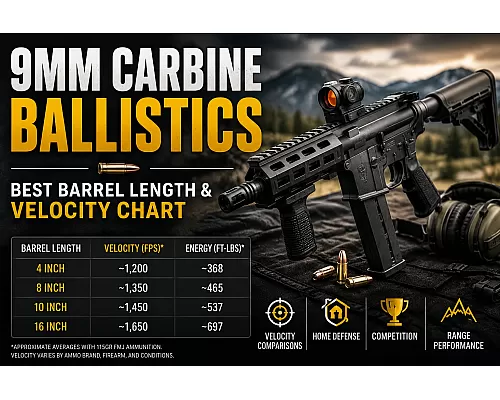
Average 9mm Velocity by Barrel Length
The following chart represents approximate velocities using common factory ammunition. Actual results vary depending on ammunition manufacturer, chamber dimensions, temperature, and chronograph conditions.
| Barrel Length | 115gr FMJ | 124gr FMJ | 147gr FMJ |
|---|---|---|---|
| 4" | 1,200 fps | 1,140 fps | 1,020 fps |
| 5" | 1,240 fps | 1,175 fps | 1,045 fps |
| 6" | 1,285 fps | 1,215 fps | 1,080 fps |
| 8" | 1,350 fps | 1,260 fps | 1,125 fps |
| 10" | 1,390 fps | 1,295 fps | 1,150 fps |
| 16" | 1,450 fps | 1,360 fps | 1,210 fps |
*Velocities are approximate averages compiled from common commercial ammunition. Individual firearms and ammunition brands may produce different results.
9mm Muzzle Energy by Barrel Length
| Barrel Length | 115gr | 124gr | 147gr |
|---|---|---|---|
| 4" | 368 ft-lbs | 358 ft-lbs | 340 ft-lbs |
| 5" | 392 ft-lbs | 380 ft-lbs | 356 ft-lbs |
| 6" | 422 ft-lbs | 406 ft-lbs | 381 ft-lbs |
| 8" | 465 ft-lbs | 437 ft-lbs | 412 ft-lbs |
| 10" | 493 ft-lbs | 462 ft-lbs | 431 ft-lbs |
| 16" | 537 ft-lbs | 509 ft-lbs | 478 ft-lbs |
4-Inch Barrel Performance
A 4-inch barrel closely matches the length found on many duty pistols. It delivers excellent maneuverability and works particularly well on compact AR-9 pistols or suppressed builds.
Advantages include:
- Extremely compact size
- Excellent for home defense
- Ideal suppressor host
- Lightweight
Disadvantages:
- Lowest velocity
- Reduced effective range
- Less energy than longer barrels
6-Inch Barrel Performance
A 6-inch barrel begins taking advantage of the additional powder burn available in the 9mm cartridge while still remaining compact enough for maneuverable defensive firearms.
Many shooters consider 6 inches the minimum "sweet spot" before velocity improvements become significant.
This configuration offers:
- Noticeably higher velocity than handguns
- Compact overall package
- Excellent suppressor compatibility
- Improved terminal performance
8-Inch Barrel Performance (Best Overall)
For most shooters, an 8-inch barrel is the ideal compromise.
It provides substantial velocity gains over pistol-length barrels while remaining much shorter and lighter than a traditional 16-inch rifle.
This is why many PCC competitors and experienced AR-9 builders choose barrels in the 8-inch range.
An 8-inch build excels in:
- Home defense
- PCC competition
- Truck guns
- Range shooting
- Suppressor use
For buyers looking for one barrel that performs exceptionally well in nearly every role, 8 inches remains our top recommendation.
10-Inch Barrel Performance
A 10-inch barrel provides slightly more velocity than an 8-inch model while maintaining excellent balance.
Many competition shooters prefer 10 inches because it offers:
- Maximum practical velocity
- Outstanding reliability
- Smooth recoil impulse
- Excellent balance for rapid transitions
The performance improvement over an 8-inch barrel is relatively modest, but shooters focused on competition often appreciate every advantage.
16-Inch Barrel Performance
A 16-inch barrel delivers the highest velocity possible without registering the firearm as a Short-Barreled Rifle (SBR) under federal law.
Benefits include:
- Maximum muzzle velocity
- Highest muzzle energy
- Longest effective range
- No SBR registration required
However, the additional six inches of barrel beyond a 10-inch setup produce relatively small velocity gains compared to the increase in overall length and weight.
For shooters prioritizing maximum compactness, shorter barrels often represent a better overall value.
How Far Is a 9mm Carbine Effective?
One of the biggest advantages of a 9mm carbine over a traditional handgun is increased effective range. The longer barrel produces higher muzzle velocity, making the bullet fly flatter while improving terminal performance.
Although the 9mm cartridge was never intended to replace rifle calibers like 5.56 NATO, it performs remarkably well inside realistic engagement distances.
| Application | Recommended Distance |
|---|---|
| Home Defense | 0–25 yards |
| PCC Competition | 0–75 yards |
| General Range Shooting | 0–100 yards |
| Experienced Marksmen | 100–150 yards |
Beyond approximately 150 yards, bullet drop increases significantly and wind drift becomes much more noticeable. While hits are certainly possible, consistent accuracy requires careful holdovers and quality optics.
Does a Longer Barrel Make a 9mm More Accurate?
This is one of the most misunderstood questions among new AR-9 builders.
The answer is: not directly.
A longer barrel does not automatically produce tighter groups. Barrel quality, ammunition consistency, trigger control, optics, and shooter skill all play much larger roles in determining mechanical accuracy.
However, longer barrels can make accurate shooting easier because they provide:
- Higher muzzle velocity
- Less perceived recoil movement
- Reduced muzzle rise
- Longer sight radius when using iron sights
- Improved shooter stability
In other words, the barrel itself isn't magically more accurate—but it often helps the shooter become more accurate.
How Much Velocity Do You Actually Gain?
Many shooters assume every additional inch of barrel adds significant velocity.
With 9mm, that's simply not true.
| Increase | Typical Velocity Gain |
|---|---|
| 4" → 6" | +70 to +90 fps |
| 6" → 8" | +50 to +70 fps |
| 8" → 10" | +30 to +40 fps |
| 10" → 16" | +50 to +70 fps |
This demonstrates why many experienced shooters stop around 8–10 inches. The velocity gains beyond that point become relatively small compared to the increase in firearm length and weight.
Which Barrel Length Is Best for Home Defense?
For defensive use inside a home, maneuverability is every bit as important as muzzle velocity.
Long barrels can be more difficult to move through hallways, around corners, or inside confined spaces.
For that reason:
| Barrel | Home Defense Rating |
|---|---|
| 4" | ★★★★★ |
| 6" | ★★★★★ |
| 8" | ★★★★★ |
| 10" | ★★★★☆ |
| 16" | ★★☆☆☆ |
An 8-inch AR-9 remains one of the most versatile defensive configurations available because it combines excellent handling with significantly higher velocity than a handgun.
Best Barrel Length for PCC Competition
Practical shooting competitions reward speed, transitions, and fast follow-up shots.
For these reasons, most competitors avoid extremely long barrels.
The most popular choices are:
- 8-inch barrels
- 10-inch barrels
These lengths provide:
- Excellent balance
- Reduced weight
- Fast target transitions
- Outstanding reliability
- Nearly maximum practical velocity
Unless local competition rules require a longer configuration, many experienced PCC shooters consider 8–10 inches the ideal setup.
Best Barrel Length for Suppressed 9mm Carbines
Suppressor users often have different priorities than other shooters.
Shorter barrels help keep the overall firearm compact while maintaining excellent reliability.
Many suppressed AR-9 owners choose:
- 4-inch
- 5-inch
- 6-inch
- 8-inch
These lengths produce a compact package while still taking advantage of the increased stability offered by a shoulder-fired firearm.
When using subsonic 147-grain ammunition, shorter barrels may also help maintain subsonic velocity, resulting in quieter suppressed performance.
Real-World Example
Consider a common 115-grain FMJ factory load.
Fired from a Glock 17 with a 4.5-inch barrel, it may average approximately 1,180 fps.
The exact same ammunition fired through an 8-inch AR-9 often reaches around 1,350 fps.
That increase translates into noticeably higher muzzle energy, improved bullet expansion for defensive ammunition, and flatter trajectories at longer distances.
Barrel Length Comparison Chart
| Feature | 4" | 6" | 8" | 10" | 16" |
|---|---|---|---|---|---|
| Velocity | ★★☆☆☆ | ★★★☆☆ | ★★★★☆ | ★★★★★ | ★★★★★ |
| Weight | ★★★★★ | ★★★★★ | ★★★★☆ | ★★★☆☆ | ★★☆☆☆ |
| Home Defense | ★★★★★ | ★★★★★ | ★★★★★ | ★★★★☆ | ★★☆☆☆ |
| PCC Competition | ★★★☆☆ | ★★★★☆ | ★★★★★ | ★★★★★ | ★★★☆☆ |
| Suppressor Use | ★★★★★ | ★★★★★ | ★★★★★ | ★★★★☆ | ★★☆☆☆ |
| Range Shooting | ★★★☆☆ | ★★★★☆ | ★★★★★ | ★★★★★ | ★★★★★ |
Frequently Asked Questions
What is the best barrel length for a 9mm PCC?
For most shooters, an 8-inch barrel provides the best balance between velocity, compact size, recoil control, and maneuverability.
Is a 16-inch 9mm worth it?
If you want maximum velocity while avoiding SBR registration requirements, absolutely. However, an 8–10 inch barrel delivers nearly all of the practical performance in a much smaller package.
How much velocity do you gain with a longer barrel?
Most factory ammunition gains approximately 150–200 fps when moving from a handgun-length barrel to an 8-inch PCC barrel. Gains beyond 10 inches become much smaller.
Is an 8-inch AR9 good for home defense?
Yes. Many shooters consider it the ideal defensive barrel because it combines compact handling with substantially improved velocity over a handgun.
What barrel length is best for suppressors?
Most suppressor users prefer barrels between 4 and 8 inches because they keep the firearm compact while often maintaining subsonic velocities with heavier ammunition.
Does a longer barrel reduce recoil?
Not directly, but the additional weight and forward balance often reduce muzzle movement, making the firearm feel softer during rapid strings of fire.
Is a longer barrel always more accurate?
No. Barrel quality, ammunition, and shooter skill determine accuracy far more than barrel length alone.
Which Barrel Length Should You Choose?
Choosing the right barrel ultimately depends on how you plan to use your firearm. While there isn't a single "perfect" barrel for everyone, there is an ideal option for nearly every type of shooter.
| If You Want... | Recommended Barrel |
|---|---|
| Maximum maneuverability for home defense | 4–6" |
| The best all-around AR-9 | 8" ⭐ Editor's Choice |
| PCC Competition | 8–10" |
| Suppressed Build | 4–8" |
| Maximum legal rifle velocity (No SBR) | 16" |
| Range shooting & steel targets | 10–16" |
If we had to recommend just one barrel for the average shooter, we'd choose the 8-inch AR-9. It offers excellent velocity, compact dimensions, manageable recoil, and outstanding versatility whether you're shooting at the range, competing, or protecting your home.
Why Choose Moriarti Armaments AR-9 Uppers?
A quality barrel is only one part of a reliable firearm. Every upper receiver should function as a complete system where the barrel, bolt, receiver, handguard, and components work together.
Moriarti Armaments AR-9 uppers are engineered to provide dependable reliability and consistent performance while offering a wide variety of barrel lengths to match your specific application.
Features Include:
- ???????? Made in the USA
- 4150 CMV & Stainless Steel barrel options
- Precision assembled and inspected
- M-LOK free-floating handguards
- Multiple barrel lengths available
- LRBHO compatible models available
- Glock & Colt magazine compatible options
- Ready-to-install complete upper assemblies
Whether you're building a compact home-defense PCC or a competition-ready AR-9, choosing the correct barrel length ensures you'll get the most performance from your investment.
Recommended AR-9 Upper Configurations
Best Compact Build
6" AR-9 Upper
Excellent for home defense, backpack builds and suppressor use.
Best Overall Build ⭐
8" AR-9 Upper
Our favorite all-around configuration combining excellent velocity with compact handling.
Best Competition Build
10" AR-9 Upper
Perfect for PCC competitions and fast transitions.
Maximum Velocity Build
16" AR-9 Upper
Ideal for shooters wanting maximum velocity without NFA paperwork.
Related Articles You May Like
Shop AR-9 Parts & Uppers
If you're ready to build your next AR-9, explore our complete lineup of high-quality components.
- AR-9 Complete Upper Assemblies
- 8" AR-9 Upper Receiver
- 16" AR-9 Competition Upper
- Browse All AR-9 Products
Final Verdict
Barrel length has a greater influence on a 9mm carbine than many shooters realize. While longer barrels do increase velocity, the improvements begin to taper off once the powder has fully burned. For most owners, carrying unnecessary weight simply isn't worth the small increase in performance.
After comparing velocity, muzzle energy, effective range, recoil characteristics, and real-world handling, we believe the 8-inch barrel remains the best overall choice for the majority of AR-9 and PCC builds. It delivers nearly all of the ballistic performance available from the 9mm cartridge while remaining compact enough for home defense, competition, and recreational shooting.
If maximum velocity without an SBR is your goal, a 16-inch rifle remains an excellent option. Shooters focused on suppressed builds or maximum maneuverability may prefer a 4- to 6-inch configuration.
No matter which barrel length you choose, selecting quality components is just as important as choosing the right dimensions. A properly built upper receiver provides the reliability, accuracy, and durability needed to get the most from every round.
Frequently Updated
This guide is reviewed and updated regularly as new ammunition, chronograph data, and AR-9 configurations become available, helping shooters make informed decisions based on current information and real-world performance.