The Bureau of Alcohol, Tobacco, Firearms and Explosives (ATF) has announced a sweeping change in federal enforcement of the National Firearms Act (NFA), effective October 9, 2026.
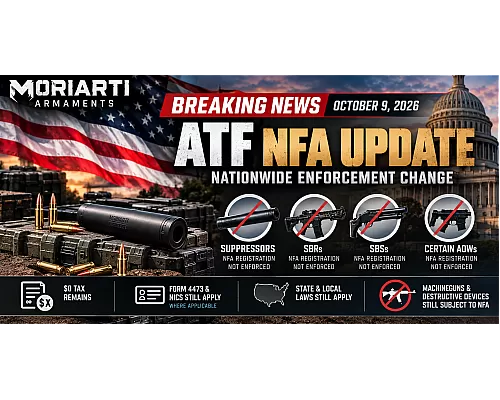
Under the new guidance, ATF will no longer enforce federal NFA application, approval, registration and tax-stamp requirements for suppressors, short-barreled rifles, short-barreled shotguns and certain firearms classified as Any Other Weapons.
The announcement represents one of the most significant changes to federal NFA enforcement in decades, with immediate implications for firearm owners, suppressor buyers, manufacturers and federally licensed dealers.
The change follows the August 2026 federal court decision in Silencer Shop Foundation v. ATF, which challenged NFA requirements following Congress's elimination of the making and transfer taxes on several NFA firearm categories.
Although that court injunction originally applied only to certain plaintiffs, the Department of Justice has now extended its nonenforcement policy nationwide.
What Changed Under the October 9 ATF Announcement?
According to the ATF's official guidance, the agency will cease enforcement of several NFA requirements for four covered categories.
These include:
Firearm suppressors and silencers
Short-barreled rifles (SBRs)
Short-barreled shotguns (SBSs)
Certain Any Other Weapons (AOWs)
For these categories, ATF will no longer require individuals to obtain NFA approval before making or transferring the covered firearms. The agency will also stop enforcing associated federal registration and tax-stamp requirements.
The policy applies nationwide beginning October 9, 2026, rather than being limited to the plaintiffs involved in the original federal lawsuit.
This does not mean the National Firearms Act has been repealed. It means ATF has announced that it will not enforce specified NFA provisions for these covered categories under its current policy.
ATF NFA Changes: Before and After October 9, 2026
Requirement | Previous NFA process | New ATF enforcement policy |
|---|---|---|
Suppressor NFA registration | Required | Not enforced |
SBR NFA registration | Required | Not enforced |
SBS NFA registration | Required | Not enforced |
Covered AOW registration | Required | Not enforced |
NFA making/transfer approval | Required | Not enforced for covered items |
NFA making/transfer tax | Reduced to $0 in 2026 | Remains $0 |
Dealer Form 4473 | Required where applicable | Still required |
Dealer NICS background check | Required where applicable | Still required |
State and local restrictions | Applicable | Still applicable |
Machinegun and destructive-device NFA rules | Applicable | Remain applicable |
The $0 NFA making and transfer tax was established separately through federal legislation. Today's announcement addresses the continued enforcement of the NFA's approval and registration requirements.
Does This Mean Suppressors No Longer Require a Tax Stamp?
Under ATF's October 9 nationwide policy, the agency will not enforce NFA tax-stamp, registration or advance-approval requirements for suppressors.
This is a significant departure from the historical federal process, in which suppressor transfers generally required an approved NFA application before delivery.
However, suppressors remain firearms under federal law, and licensed dealers must continue complying with applicable Gun Control Act requirements.
These include Form 4473, NICS background checks, required dealer records and other federal transfer restrictions.
State and local laws may also impose additional requirements or prohibit suppressor possession altogether.
What Does the ATF Announcement Mean for Short-Barreled Rifles?
The October 9 guidance is equally significant for SBRs.
A short-barreled rifle has historically been subject to the NFA's registration and approval requirements, including firearms meeting the applicable statutory definitions based on barrel length or overall configuration.
Under the new federal nonenforcement policy, ATF will not require NFA making approval or registration for covered SBRs.
For AR-platform enthusiasts, this development could significantly change how compact rifle configurations are evaluated under federal enforcement policy.
However, firearm classification, Gun Control Act provisions and state-specific SBR restrictions remain important.
Additionally, ATF states that the separate federal requirement for approval before transporting an SBR or SBS interstate remains in effect. That approval is obtained through ATF Form 5320.20, commonly called Form 20.
What About Machineguns and Destructive Devices?
The October 9 guidance does not eliminate NFA requirements for all federally regulated firearms.
Machineguns and destructive devices remain subject to the NFA's registration, approval and applicable taxation provisions.
ATF has confirmed that the $200 tax remains in place for these categories and that their existing NFA requirements continue to apply.
The new policy is specifically directed at the firearm categories for which Congress eliminated the NFA making and transfer taxes.
What Happens to Existing NFA Registrations?
Owners who already possess registered suppressors or SBRs should understand that the new policy does not automatically erase historical registration records.
ATF has also indicated that it will continue accepting and processing NFA applications, particularly because some state laws still require federal registration.
This creates an important distinction between a federal nonenforcement policy and the legal requirements that may exist in an individual state.
ATF has further cautioned that there is no automatic grandfathering protection for unregistered NFA items if the legal circumstances change in the future.
That uncertainty makes the distinction between current enforcement policy and permanent statutory reform especially important.
What Does This Mean for Firearms Dealers and Manufacturers?
The October 9 announcement also changes how federally licensed firearms businesses may handle covered NFA firearms.
ATF's guidance addresses several important dealer and manufacturer requirements:
Suppressor transfers: Licensed dealers may process eligible suppressor transfers under applicable Gun Control Act procedures, including Form 4473 and NICS background checks.
Dealer-to-dealer transfers: ATF will no longer require Form 3 approval for covered suppressor and AOW transfers between FFLs, although voluntary NFA submissions remain available.
SBR and SBS transfers: ATF acknowledges that a separate Gun Control Act approval requirement exists for dealer transfers of short-barreled rifles and shotguns. The agency says it will temporarily exercise enforcement discretion while developing a new non-NFA approval process.
Manufacturers: Appropriate federal licensing, firearm marking and serialization requirements continue to apply under the Gun Control Act.
Special Occupational Tax: Businesses engaged in manufacturing, importing or dealing in covered NFA firearms must continue paying the applicable occupational taxes.
These distinctions are particularly important for licensed manufacturers and dealers because the elimination of NFA registration enforcement does not eliminate their other federal obligations.
What Does This Mean for Suppressor-Ready AR Firearms?
The new ATF guidance arrives as suppressor-ready AR platforms continue attracting attention across the firearms industry.
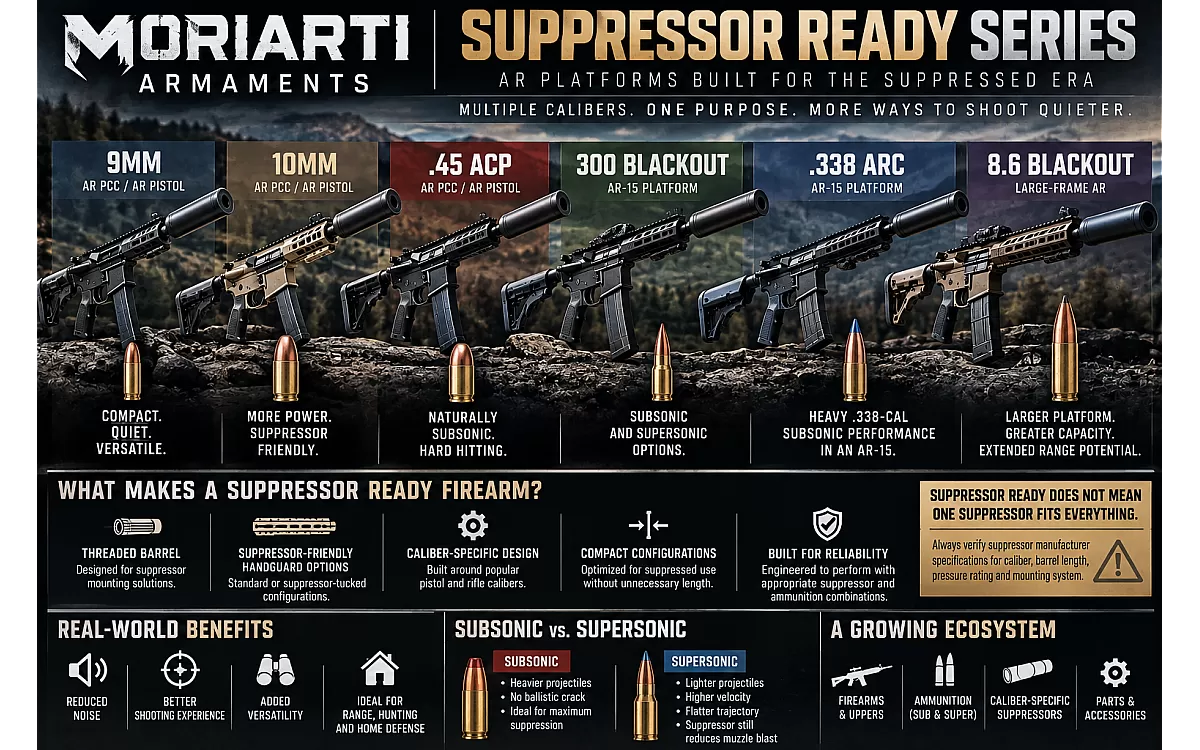
For customers exploring compact AR configurations, pistol-caliber carbines, 300 Blackout, .338 ARC and 8.6 Blackout, the announcement changes the federal NFA enforcement landscape surrounding compatible suppressors and short-barreled rifle configurations.
Moriarti Armaments continues to expand its dedicated Suppressor Ready Series, bringing multiple AR-platform configurations together under one product family.
However, suppressor compatibility remains a separate technical consideration. Buyers must verify cartridge ratings, mounting requirements and minimum barrel lengths before pairing a suppressor with any firearm.
The October 9 guidance also does not override state-specific restrictions on suppressors or SBRs.
Frequently Asked Questions About the October 9 ATF NFA Changes
Did ATF eliminate suppressor registration nationwide?
ATF announced that it will no longer enforce NFA registration requirements for suppressors nationwide, effective October 9, 2026. The underlying statute has not been repealed.
Do SBRs still require a Form 1?
Under ATF's new federal enforcement policy, Form 1 approval is no longer enforced as a prerequisite for making a covered SBR. Voluntary registration remains available, and state restrictions continue to apply.
Can I buy a suppressor without a Form 4?
Under the October 9 policy, ATF will not require NFA Form 4 approval for covered suppressor transfers. Licensed dealers must still comply with applicable Gun Control Act procedures, including Form 4473 and NICS checks.
Are machineguns included in the new ATF policy?
No. Machineguns and destructive devices remain subject to the existing NFA registration, approval and applicable taxation requirements.
Do state suppressor and SBR laws still apply?
Yes. ATF expressly confirms that the new guidance does not override state or local laws. Some jurisdictions prohibit certain NFA firearms, while others may require federal registration as a condition of lawful possession.
Can the new ATF policy be reversed?
Yes. ATF acknowledges that future legislation, litigation or changes in enforcement policy could restore NFA enforcement. The agency also warns that unregistered items are not automatically grandfathered if the legal situation changes.
A Historic Change in Federal NFA Enforcement
The October 9, 2026, ATF announcement marks a major turning point in federal firearms regulation.
What began as a dispute over the constitutionality of NFA registration requirements following the elimination of certain making and transfer taxes has now resulted in a nationwide federal nonenforcement policy.
For suppressor owners, SBR enthusiasts, firearms manufacturers and dealers, the implications are substantial.
But the most important distinction remains: ATF has changed its enforcement policy; Congress has not repealed the NFA.
As the firearms industry adjusts to the new guidance, the interaction between federal policy, state law and future court decisions will remain important.
Moriarti Armaments will continue following developments affecting suppressors, short-barreled rifles and AR-platform firearms as additional federal guidance becomes available.
Official sources: ATF October 9 Press Release | ATF Updated NFA Guidance and FAQs
This article provides general information about federal firearms regulatory developments as of October 9, 2026. It is not legal advice. Firearm owners and dealers should verify applicable federal, state and local requirements before making, purchasing, transferring or transporting regulated firearms.